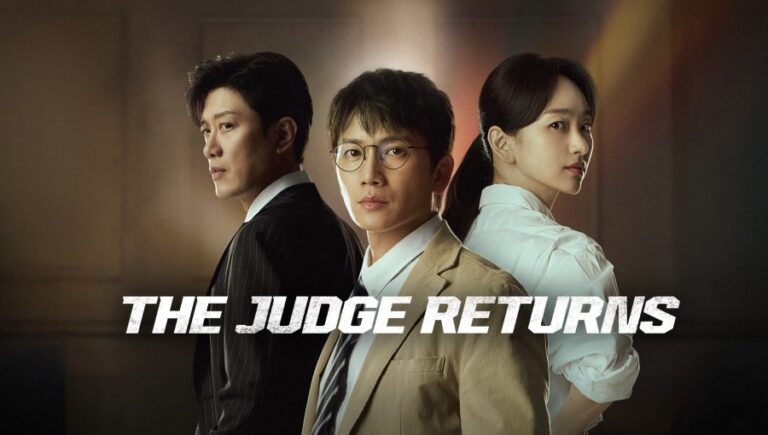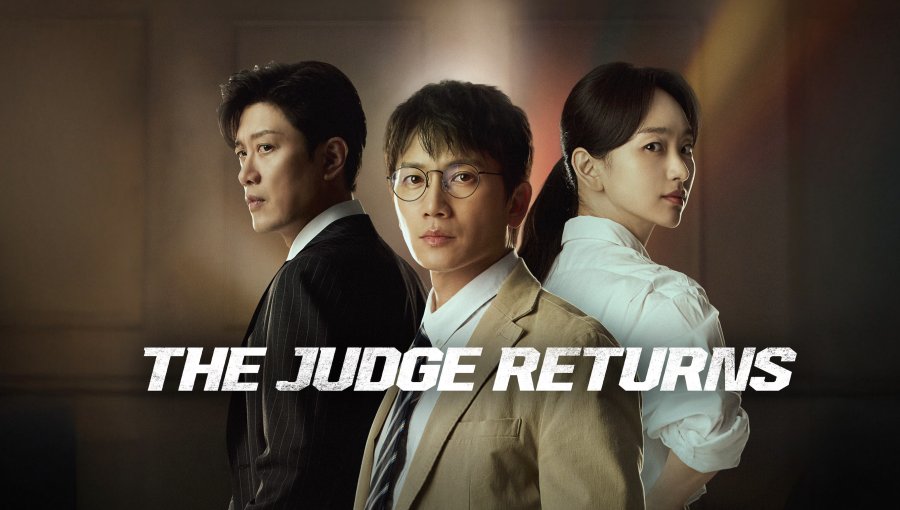
The Judge Returns (2026) – What happens when a man who sold justice is given the rare gift of buying it back?
That’s not a rhetorical question. It’s the moral engine driving The Judge Returns (판사 이한영), MBC’s January 2026 legal fantasy thriller, and it’s the kind of question that separates a genuinely compelling drama from one that just wears the costume of depth.
Most legal dramas are about catching the guilty. This one is about a man who was the guilty, and what he does with a second chance he never deserved.
The Setup: A Crooked Judge, a Clean Conscience (Too Late), and a Do-Over
Lee Han Young (Ji Sung) is not your typical drama protagonist. He’s not misunderstood. He’s not framed. He is, by every reasonable measure, a corrupt judge, brilliant, calculating, and willing to bend the law for the right people, particularly his father-in-law’s powerful law firm, Haenal Law Firm.
His backstory is quietly devastating: a man from a modest background who understood early that in Korea’s rigidly hierarchical legal world, pedigree matters more than principle. So he made a transaction. He married into power, traded his integrity for access, and spent years making sure the right verdicts landed in the right hands.
It worked – until it didn’t.
His breaking point comes when he handles a case involving the chairman of a major corporation, someone clearly guilty, clearly protected. For the first time, Han Young refuses. He hands down a life sentence. The system he served for years turns on him. He ends up dead.
Then he wakes up ten years in the past.
The Time Travel That Isn’t Really About Time Travel
Here’s where The Judge Returns makes a quietly bold choice: it uses time travel not as spectacle, but as a moral stress test.
Han Young doesn’t go back with superpowers. He goes back with memory, and that’s far more interesting. He remembers every corrupt deal, every verdict he buried, every person the system destroyed while he looked the other way. He knows exactly how the next decade plays out, and he knows exactly how much of it was his fault.
The drama asks: if you knew the consequences of every choice you ever made, would that be a gift or a punishment?
For Han Young, it’s both. His knowledge lets him anticipate threats and outmaneuver enemies. But it also means he can’t lie to himself anymore. Every shortcut he’s tempted to take, he knows where it leads. Every face he recognizes carries the weight of what he failed to do for them the first time around.
This is time travel as moral clarity, not escapism. The fantasy element earns its place precisely because it’s not treated as fantasy, it’s treated as consequence.
The Antagonist: Power That Doesn’t Need to Hide
Kang Shin Jin (Park Hee Soon) is one of the most unsettling antagonist archetypes in recent Korean drama, not because he’s theatrical, but because he’s institutional.
As Chief Judge of the Criminal Division at Seoul Central District Court, Kang Shin Jin doesn’t operate in the shadows because he’s afraid of the light. He operates there because he’s built a system where the light never reaches him. Backed by a network connected to a former South Korean president, he represents something scarier than a villain: a structure.
He doesn’t threaten Han Young because he’s threatened by him personally. He moves against him the same way a body’s immune system attacks foreign matter, automatically, efficiently, without malice. That’s what makes him compelling. Kang Shin Jin doesn’t hate injustice. He simply doesn’t register it as relevant.
His coldness is the drama’s most effective visual metaphor for systemic corruption: it doesn’t need passion to sustain itself, just momentum.
Kim Jin A: The Idealist Who Refuses to Be Naive
Kim Jin A (Won Jin A) functions as the drama’s moral compass, but to the writers’ credit, she’s not a simple one.
She’s a prosecutor who became one for deeply personal reasons: to bring down Jang Tae Sik, an executive of the S Group conglomerate, for something connected to her past. She’s sharp, principled, and deeply skeptical of Han Young when they first meet, because she knows his record.
That tension is one of the drama’s smartest ongoing threads. Kim Jin A isn’t blindly won over by Han Young’s apparent change of heart. She watches him, tests him, and keeps a calculated distance even as they work together. In lesser dramas, the idealistic character exists to be inspired by the reformed antihero. Here, she makes him work for every inch of trust, and that dynamic gives the partnership real texture.
Her presence also raises a question the drama lets simmer: is Han Young actually changing, or is he just rerouting his ambition toward redemption because it’s the only play left?
What the Drama Gets Right, and Where It Earns Its Premium Slot
Ji Sung’s performance is the load-bearing wall of the entire production. He plays Han Young’s interior life through restraint rather than exposition, a man who knows things he can’t explain, who carries regret he can’t articulate, who is simultaneously guilty and trying. There’s a scene in the early episodes where he sits across from someone he failed in his previous life, someone who doesn’t know him yet, and the weight of what Ji Sung communicates without a word of dialogue is genuinely impressive.
The 14-episode structure works in the drama’s favor. There’s no padding, no filler arc to justify a 16-episode run. The story knows what it wants to say and moves toward it with purpose.
The legal procedural elements are handled with unusual specificity, this isn’t a drama that uses “court scenes” as set dressing. The mechanics of how verdicts are influenced, how pressure moves through judicial hierarchies, and how power insulates itself feel researched and credible.
Where the drama is more uneven: some of the supporting characters in the Cheonan Branch storyline (where Han Young begins his second timeline) feel underdeveloped relative to the central trio. And the pacing in the middle stretch of episodes occasionally loses its footing, slowing where the stakes should be tightening.
But these are quibbles against a drama that is, structurally and thematically, operating at a level above most of its genre peers.
The Deeper Theme: Not Redemption – Accountability
It would be easy to frame The Judge Returns as a redemption story. The corrupt man gets a second chance, does the right thing this time, earns forgiveness.
But the drama is more honest than that, and more uncomfortable.
Han Young can change outcomes. He can prevent crimes, protect victims, and dismantle the system he once served. But he can’t undo what he did the first time. The people he hurt in the original timeline still exist in the world with those wounds, even if this version of events never delivered them.
The drama treats this with unusual seriousness. Han Young doesn’t get to feel clean. His second chance doesn’t come with a clean slate, it comes with the full weight of knowing what he was, layered onto every decision he makes now.
That’s not redemption. That’s accountability. And the distinction matters, because redemption is something you receive. Accountability is something you carry, permanently, without guarantee of absolution.
That’s a harder truth than most dramas are willing to tell.
Final Verdict: Required Viewing for Fans of Smart Legal Drama
The Judge Returns is the rare K-drama that commits fully to its premise and trusts its audience to sit with moral ambiguity. It’s not trying to make you like Lee Han Young. It’s trying to make you think about what it means to want to undo the worst of yourself, and whether wanting it badly enough changes anything.
Ji Sung delivers career-caliber work. Park Hee Soon is quietly terrifying. Won Jin A brings a precision to Kim Jin A that the character demands. And the adapted source material, Lee Hae Nal’s 2018 Naver web novel, provides a structural backbone strong enough to support the drama’s ambitions without collapsing under them.
If you watch Korean drama for the legal intrigue, the performances, or the philosophical weight, this one earns your time.
And if you’ve ever made a decision you’d give almost anything to unmake, The Judge Returns will feel uncomfortably personal.
Drama Details
| Title | The Judge Returns (판사 이한영) |
| Network | MBC |
| Episodes | 14 |
| Runtime | ~70 min/episode |
| Airing | Jan 2 – Feb 14, 2026 (Fri & Sat) |
| Cast | Ji Sung, Park Hee Soon, Won Jin A |
| Genre | Legal / Action / Fantasy / Mystery |
| Rating | 15+ |