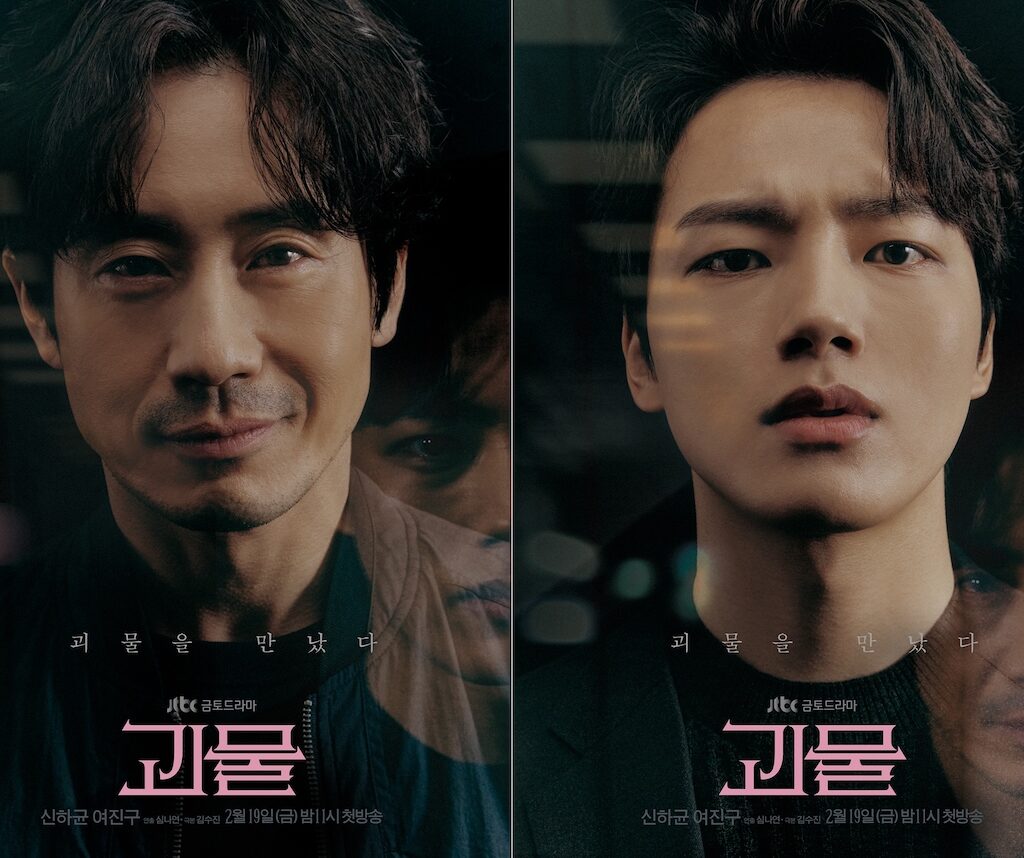
I’ll be upfront about something before we get into this: I’m not a neutral party here. Beyond Evil is one of my favorite Korean dramas, full stop, and a big chunk of that comes down to the two men at the center of it. So consider this less of a clinical breakdown and more of a love letter with a synopsis attached.
Beyond Evil is a psychological thriller that aired on JTBC from February 19 to April 10, 2021, across 16 episodes. Shin Ha-Kyun and Yeo Jin-Goo lead the cast, Shim Na-Yeon directed, and Kim Soo-Jin wrote the script. The show took over the Friday-Saturday slot that Hush had just vacated, and by the time it wrapped, it had quietly become one of the most talked-about thrillers of that year.
What’s It About
Lee Dong-Sik (Shin Ha-Kyun) used to be one of the good detectives, sharp, respected, the whole package. Now he’s just an officer at the Manyang Police Substation, stuck doing the kind of paperwork-heavy, nothing-ever-happens-here work that fills up a day without meaning anything.
That quiet life gets disrupted the moment Han Joo-Won (Yeo Jin-Goo) shows up. He’s young, he’s from Seoul, he’s got an elite record, and he’s the son of a man who’s about to become National Police Chief. He also came to Manyang carrying a secret he’s not exactly eager to share.
Then the murders start. A string of killings that mirrors a case from 20 years back, one that never really left Dong-Sik alone, even after all this time. The two men end up forced into working the case side by side, and the deeper they dig, the less clear it becomes who they should actually trust. Including each other. Including themselves.
The Cast
| Actor | Character |
|---|---|
| Shin Ha-Kyun | Lee Dong-Sik |
| Yeo Jin-Goo | Han Joo-Won |
| Choi Sung-Eun | Yoo Jae-Yi |
| Choi Dae-Hoon | Park Jung-Je |
| Kim Shin-Rok | Oh Ji-Hwa |
| Heo Sung-Tae | Lee Chang-Jin |
| Gil Hae-Yeon | Do Hae-Won |
| Nam Yoon-Soo | Oh Ji-Hoon |
| Chun Ho-Jin | Nam Sang-Bae |
And that’s really just the front line. The supporting cast in this show pulls a lot of weight too, nobody feels like filler.
Lee Dong-Sik: The Detective Everyone (Including the Show) Suspects
Here’s the thing about Dong-Sik: he smiles constantly, he’s a little unpredictable, he runs on impulse more than strategy, and none of that reads as an act. It’s exactly who he is. But underneath all of it is a grief that’s never really healed, tied to losing his twin sister, Yu-Yeon, decades ago.
What makes Shin Ha-Kyun’s performance so good is that he never lets you settle into one read of this guy. One scene he’s the most sympathetic person in the room, the next you’re second-guessing whether he’s capable of something terrible. That’s the whole engine of the show, honestly, and he plays it note-perfect. It’s the kind of role that stays with you well after the credits roll.
Han Joo-Won: Cold on the Surface, a Mess Underneath
Joo-Won is introduced as the golden boy, buttoned-up, precise, seemingly without a single flaw. Of course, that’s never actually true of anyone, and it’s definitely not true of him. He arrives in Manyang planning to investigate Dong-Sik, half-convinced the guy is guilty of something. What he doesn’t expect is how much his own certainty starts cracking the longer he stays.
Yeo Jin-Goo takes a character who could’ve been a stiff, one-note “rule follower” archetype and turns him into someone genuinely difficult to read, someone who thaws out in ways that feel earned rather than convenient. Watching him go from suspicious outsider to someone who’d go to the wall for Dong-Sik is one of the most satisfying arcs in the whole show.
And here’s a detail I love: this wasn’t the first time these two actors shared a screen. Back in 2006, they appeared together in the film No Mercy for the Rude, Yeo Jin-Goo actually played the younger version of Shin Ha-Kyun’s character. So by the time Beyond Evil happened, there was already a strange, built-in familiarity between them, even if most viewers didn’t clock it at the time.
Light Spoilers: How It Starts
In episodes 1 and 2, Joo-Won lands in Manyang and immediately zeroes in on Dong-Sik as his prime suspect. Before the second episode ends, though, a woman’s body turns up buried in a field, and suddenly the case isn’t hypothetical anymore. Old wounds reopen, and the real investigation kicks off.
By episodes 3 and 4, we learn that Kang Jin-Mook, father of the newest victim, is hiding something ugly. But his arrest doesn’t close anything. If anything, it blows the case wide open, Jin-Mook dies by suicide in his cell, leaving behind a note insisting he had nothing to do with Yu-Yeon’s death all those years ago.
The Ending: So, Who’s the Monster?
By the final episode, all the threads pull together. The person actually responsible for Yu-Yeon’s death is revealed to be Han Ki-Hwan, Joo-Won’s own father, who hit her while driving drunk. Politician Do Hae-Won and businessman Lee Chang-Jin helped bury the truth for decades.
Dong-Sik and Joo-Won bring them down together, even if it means crossing lines they shouldn’t. Once the arrests are made, Dong-Sik turns himself in for tampering with evidence during the investigation and serves a year in prison. Joo-Won, who at one point wanted out of the police force entirely, ends up transferring to the unit that handles crimes against women and children instead.
The last scene is a warm, unhurried reunion at a restaurant in Manyang, two men who spent 16 episodes questioning everything about each other, finally just sitting there, at ease. It’s not a flashy ending. It’s a quiet one. And honestly, that’s exactly why it works.
A Few Things Worth Knowing
Beyond Evil didn’t just do well with viewers, it swept the 57th Baeksang Arts Awards in a real way, walking away with Best Drama, Best Actor for Shin Ha-Kyun, and Best Screenplay for Kim Soo-Jin, out of seven total nominations. It was also shortlisted for the ceremony’s Grand Prize in Television, which is about as high as recognition gets in Korean TV.
People online tend to connect the plot to Korea’s real Hwaseong serial murder case, and the resemblance is there, but according to reporting around the show, that similarity is more about the influence of Bong Joon-ho’s Memories of Murder (2003) than a direct retelling of the real case. Beyond Evil is fiction, not a dramatization.
The soundtrack deserves its own paragraph, honestly. “The Night” by Choi Baek-ho and “Timeless” by BIBI are the two tracks people talk about most, but the album also includes “Empty” by Car The Garden and “The Road” by SunWoo JungA, and the score itself leans into a moody, jazz-inflected, almost film-noir atmosphere that suits the show’s tone perfectly.
If you’re wondering whether this one has any kind of continuation, not exactly a sequel, but there is a Japanese adaptation called Kaibutsu, which aired on WOWOW in 2025. If you’ve seen that version and are curious about the original, this is your sign to go watch Shin Ha-Kyun and Yeo Jin-Goo do it first.
One more thing for anyone about to dive in: this isn’t a light watch. Streaming platforms list it with a fairly heavy content advisory, violence, substance use, alcohol use, smoking, strong language, and some sexual content. Go in knowing that, especially if you’re used to lighter K-drama fare.
Should You Watch It?
If you’ve got the patience for a slow burn, and I do mean slow, the first couple episodes are all setup, Beyond Evil pays that patience back tenfold. It’s not really a whodunit in the traditional sense. It’s more interested in what happens to people who’ve spent their whole lives chasing monsters, and what it costs them to catch one.
Five years later, I still think about this show more than dramas that came out last month. That should tell you something.