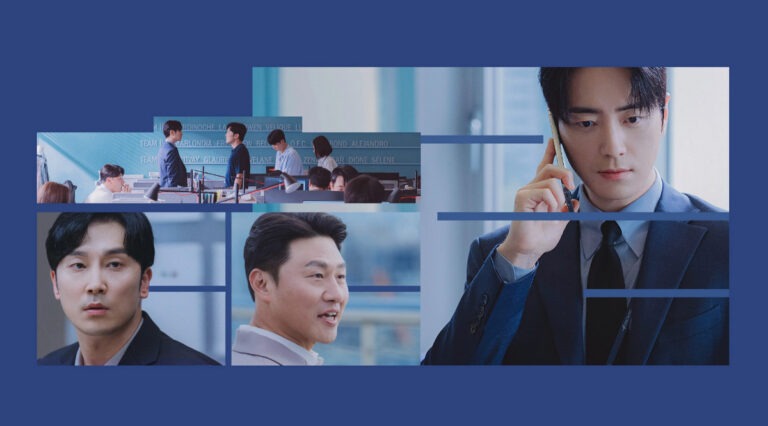
Episode 7 of The Judge Returns opens with a defining moment for Lee Han-young. Standing face to face with Mayor Choo Yong-jin, Han-young comes dangerously close to crossing a line he can never return from. Years of suppressed anger weigh heavily as he raises a rock, ready to strike.
But he stops.
That hesitation matters. It clarifies everything about Han-young’s character. He is not driven by the desire to kill. What he wants is accountability.
Instead of taking the mayor’s life, Han-young chooses something far more destructive for the powerful: the law. From that moment on, the episode frames a central question, what does justice really mean inside a system designed to protect those at the top?
The Nammyeon-gu sinkhole scandal explodes across the media. News cameras chase suspects, headlines multiply, and public outrage grows by the hour. Assemblyman Woo quickly becomes the symbol of corruption, while pressure spreads to everyone connected to the case.
The drama captures this chaos effectively. The noise feels overwhelming, mirroring how real-life scandals spiral out of control once they enter the public sphere.
Amid the frenzy, Han-young remains composed. He understands that panic is a luxury he cannot afford. Every move must be calculated. Every reaction must serve a larger strategy.
While the scandal grows darker, the episode offers moments of quiet warmth through Na-young. Han-young and Jeong-ho care for her with gentle restraint, giving her a sense of safety she has rarely experienced. Her smile feels earned, especially when she tells her grandmother that she finally feels protected.
Yet Han-young knows the danger has not disappeared. As long as Na-young continues working at S Group’s chemical lab, her life remains at risk. Protecting her becomes another silent mission, one he cannot openly acknowledge. This subplot adds emotional depth and reminds viewers that justice extends beyond courtrooms, it is also about preventing unseen tragedies.
Kang Shin-jin tightens his grip on the sinkhole investigation, driven by ambition and the promise of power. During his inquiry, he uncovers Han-young’s buried history. Han-young’s father was falsely accused, sacrificed to protect Tae-sik.
The revelation shakes Shin-jin. Han-young’s actions suddenly take on new meaning, and their alliance begins to feel unstable.
Their tense lunch meeting says everything without saying much at all. When Shin-jin asks what Han-young truly wants, Han-young offers only a vague response, that the truth will reveal itself soon. The answer feels ominous, hinting at long-term plans and unresolved vengeance.
Elsewhere, Song Na-yeon carefully gathers testimonies from victims, strengthening Han-young’s legal strategy. Her role becomes increasingly vital. Prosecutor Jin-a also emerges as a key figure. Han-young recognizes her strong sense of justice, though he knows it must be approached with caution.
Every character now moves steadily toward the courtroom. The series effectively shows how quiet, behind-the-scenes work shapes what ultimately happens in public trials.
The first sinkhole trial finally opens. Inside the courtroom, Han-young comes face to face with Yoo Ha-na, his sister-in-law from his previous life. He conceals his emotions well, offering only a subtle smirk that suggests fate has granted him another opportunity.
Publicly, Han-young appears to assist the Haneul law firm. Privately, he ensures that nothing truly benefits them. When a shocking video linked to the mayor’s office is revealed, the courtroom erupts. Panic spreads among the defense, and the balance of power shifts instantly.
The scene highlights just how fragile influence becomes once real evidence enters the room.
Sensing the growing chaos, Shin-jin strangely advises Mayor Choo to take a short holiday. The suggestion feels wrong from the start. Soon enough, it turns deadly when an assassin is sent to kill the mayor during the trip.
Just as the plan unfolds, Han-young intervenes. The rescue is fast and brutal, ending the episode on a sharp cliffhanger where justice and violence sit uncomfortably close together.
Episode 7 sharpens both the emotional and political edges of The Judge Returns. Han-young’s refusal to kill Mayor Choo defines his character more clearly than any speech could. He seeks punishment, not personal satisfaction.
The sinkhole scandal feels realistic in its scale and consequences. Media pressure, public outrage, and legal maneuvering blend seamlessly. Shin-jin’s discovery of Han-young’s past deepens every interaction, while the courtroom scenes feel urgent and alive. The assassination twist raises the stakes without feeling forced, reinforcing the idea that powerful figures rarely fall quietly.
Episode 8 wastes no time pulling viewers back into turmoil. Opening moments after the attempted assassination, Han-young throws himself into danger to save Mayor Choo. The rescue is chaotic and raw. Jeong-ho ultimately stops the assassin, though the attacker escapes before any answers can be extracted.
The irony cuts deep. The mayor survives because of Han-young, yet remains unaware of who saved him. That ignorance fuels tension throughout the episode. Shin-jin senses something is wrong. Since Han-young’s arrival, carefully constructed plans have begun to collapse.
Shaken by fear and guilt, Mayor Choo makes an unexpected decision. He agrees to cooperate with the police and reveal the truth behind the sinkhole scandal. The shift feels earned rather than convenient. The series allows guilt to drive accountability instead of self-preservation.
The pacing is sharp. Information moves quickly but never feels rushed. After several episodes of buildup, Episode 8 finally delivers. The sinkhole case transforms from a symbol of corruption into an active threat to those in power.
The danger here is quiet, but irreversible.
Prosecutor Jin-a faces one of her toughest moral dilemmas. She holds documents capable of destroying Assemblyman Woo, but using them would shake the political system. Woo attempts to shield himself by exploiting his daughter’s alleged depression, turning personal suffering into a legal defense.
Jin-a refuses to participate.
Her calculated visit to the bar where Woo’s daughter spends time sets events into motion. When the drug arrest becomes public, Woo’s confidence collapses instantly. The moment is not portrayed as a triumphant victory, but as a disturbing necessity. Justice here comes with personal cost, making it feel uncomfortably real.
The message is clear: power does not fall cleanly, it fractures.
As pressure mounts, Assemblyman Jeong-tae’s office is raided, pushing events beyond control. Shin-jin responds with ruthless efficiency, ordering Jeong-tae’s assassination without hesitation.
The attack is swift and brutal. Prosecutor Cheol-woo becomes collateral damage. Though he survives, the trauma is evident. The camera lingers on his shaken expression, reminding viewers that survival does not mean escaping unscathed.
At this point, political maneuvering is no longer enough. Fear has entered the equation.
The emotional core of Episode 8 lies in the quiet lunch between Han-young and Shin-jin. On the surface, the meeting appears polite. Beneath it, every word carries weight.
Han-young claims he seeks revenge against the judge who wrongfully sentenced his father. The performance is convincing. Shin-jin listens carefully, testing sincerity through silence rather than confrontation. No threats are spoken, yet the tension is unmistakable.
This is where The Judge Returns excels. Power is not shouted, it is negotiated.
As the pressure intensifies, Han-young chooses to hide his meeting with Shin-jin from Yi-seok. His intention may be protective, but secrecy creates distance. Trust begins to erode.
The episode’s final moments deepen the unease. In a private conversation, Han-young speaks about taking Yi-seok down for good. The line lands hard. Whether this is strategy, misdirection, or genuine betrayal remains unclear.
The ambiguity is deliberate, and effective.
Episode 8 stands out not for spectacle, but for shifting loyalties. Mayor Choo’s cooperation feels like the first honest act within a deeply dishonest system. Jin-a’s decision reinforces the idea that justice in this world is intentionally uncomfortable.
Most compelling is Han-young’s double game. His control remains intact, but the emotional cost is starting to surface. The ending leaves viewers questioning his limits and his true intentions.
With the line between law and violence growing thinner, The Judge Returns continues to build tension that refuses to resolve cleanly, and that is precisely what makes it compelling.