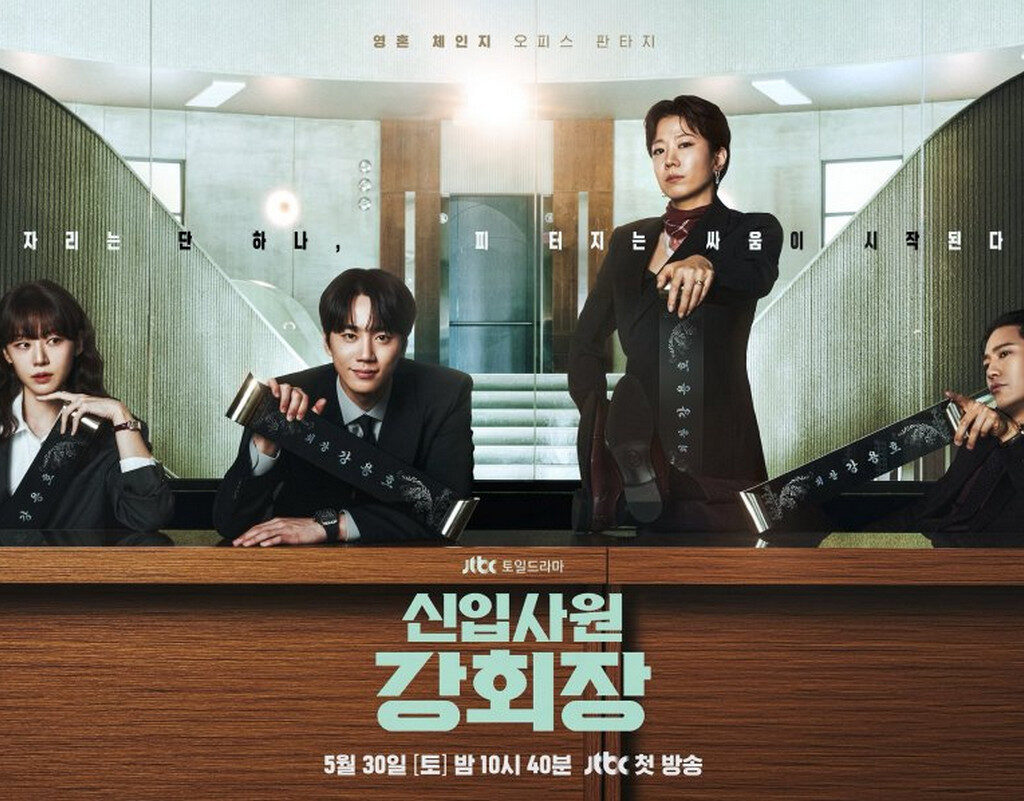
Reborn Rookie Episodes 1-2 Review – What happens when a ruthless billionaire wakes up in the body of the young footballer he indirectly destroyed? That’s the provocative premise at the heart of Reborn Rookie, a Korean drama that arrives dressed as a light corporate comedy but quietly smuggles in something sharper, a story about power, legacy, and what it costs a man to truly see himself.
The first two episodes are messy, frantic, and at times borderline absurd. But underneath the chaos, there’s a genuinely interesting drama trying to find its footing.
Episodes 1-2 Recap: The Crash That Changed Everything
Episode 1: A Life Derailed
Kang Yong-ho, the ageing chairman of the powerful Choiseong Group, announces his retirement and sets off a quiet war between his twin children, the calculating Jae-gyeong and the impulsive Jae-seong. While the family circles the throne, Hwang Jun-hyeon, a hopeful young footballer, signs his dream contract with FC Choiseong.
That dream shatters the same night. Jae-seong, distracted while trying to watch dashcam footage from his father’s car, runs a red light and hits Jun-hyeon. The twins cover it up immediately, erasing CCTV evidence, silencing witnesses, leveraging every advantage their wealth affords.
Jun-hyeon wakes up facing surgery, a career-ending knee injury, and a penalty clause in his contract. His only lifeline is a grandmother with dementia who has always believed in him. When he tracks down Yong-ho and demands accountability, he’s met not with an apology but a blank cheque, a chilling symbol of how the wealthy translate guilt into transaction.
The episode ends in a collision, literally. Jae-seong knocks his father down a staircase; Yong-ho falls onto Jun-hyeon. When Yong-ho wakes up in the hospital, he’s in the wrong body.
Episode 2: The Old Man Loose in a Young Man’s World
Episode 2 accelerates the madness. Yong-ho, now trapped inside Jun-hyeon’s body, has to navigate a world that used to serve him, except now no one recognises him as anyone important. The twins, oblivious to the soul-switch, attempt to manipulate “Jun-hyeon” into covering for them publicly, and Jae-gyeong’s husband even tries to quietly ensure Yong-ho’s body never wakes up.
Meanwhile, Bang-geul, Yong-ho’s eldest daughter from his first marriage, hiding her identity while working as an intern at Choiseong, surfaces as a wildcard. She’s been quietly collecting information on her half-siblings and seems to have her own agenda entirely.
The episode’s most significant turn comes when Yong-ho, instead of demanding money with the blank cheque Jun-hyeon had filled out, asks for a job at Choiseong. He’s now inside the company he built, invisible, underestimated, and watching everything.
Story Analysis: Power Seen from the Bottom
The central tension of Reborn Rookie isn’t really about whose body anyone is in, it’s about perspective. Yong-ho has spent decades operating from the top of a hierarchy he created. The body swap strips him of every material advantage and forces him to experience the world his decisions shaped.
The drama draws a sharp line between two types of people in Yong-ho’s life: those who feared him and those who were destroyed by the machinery he operated. Jun-hyeon represents the latter, not a villain, not a rival, just a young man with a dream who happened to be in the wrong place at the wrong time.
The show’s thematic engine runs on class and accountability. Yong-ho didn’t hit Jun-hyeon with the car, his son did, but the entire infrastructure that enabled the cover-up was Yong-ho’s creation. His wealth, his influence, his children who grew up believing consequences were optional. In a quiet way, the drama is asking: how much of what your system produces are you responsible for?
Corporate succession drama and body-swap comedy aren’t natural bedfellows, but Reborn Rookie commits to both. The boardroom politics feel real enough to generate stakes, and the fish-out-of-water comedy lands when it doesn’t try too hard.
Character Development: Who Are These People, Really?
Kang Yong-ho
At first glance, Yong-ho reads as the standard cold patriarch, disappointed in his children, too proud to apologize, more comfortable writing cheques than having honest conversations. But two episodes in, cracks are already visible.
His decision to publicly sacrifice his own reputation, as Jun-hyeon, at the press conference, is the drama’s first sign that Yong-ho is capable of something beyond self-preservation. He doesn’t have to do it. He could let the twins spin their narrative. Instead, he chooses accountability, even if it means the man everyone thinks he is takes the fall.
The tragedy here is timing. It takes losing everything, identity, status, body, for Yong-ho to start acting with integrity.
Hwang Jun-hyeon
Jun-hyeon barely gets to be a character before the soul-switch happens, but what we see matters. He’s not reckless or naive, he’s simply someone who trusted that systems would work fairly and was proven catastrophically wrong. His refusal of Yong-ho’s initial compensation offer is one of the episode’s most dignified moments. So is the painful reversal when he fills in the cheque anyway, because Ok-sun’s care costs money that dignity alone can’t provide.
Bang-geul
She’s the show’s most intriguing element right now. Hiding her identity, gathering intelligence, neither siding with the twins nor revealing herself to her father, Bang-geul operates with a quieter kind of strategy than anyone else in the cast. Her relationship with “Jun-hyeon” (actually her father) promises to be the drama’s emotional centrepiece, and the writers seem to know it.
The Twins
Jae-gyeong and Jae-seong function as a unit rather than individuals through these early episodes. Jae-gyeong is the colder strategist; Jae-seong is impulsive and easily panicked. Neither is written with much complexity yet, though Jin Goo’s casting as the reckless Jae-seong is an interesting choice, he brings enough weight to suggest the character might become more layered as the series progresses.
Key Moments That Shape the Story
The Blank Cheque Scene is the drama’s thesis statement in a single prop. Yong-ho hands Jun-hyeon a blank cheque and tells him to write what he thinks he’s worth. It’s degrading in a way that money often is when deployed as a substitute for humanity. Jun-hyeon’s initial refusal, and then his return, captures the exact tension the show wants to explore: what do principles cost when someone you love needs care?
The Press Conference is the first moment Yong-ho surprises us. Operating in a body no one recognises, stripped of all leverage, he still chooses to tell a version of the truth. It doesn’t fully exonerate him, but it’s the first time he acts against his own interest for someone else’s benefit.
Jae-gyeong’s Attempted Smothering is the episode’s darkest beat, and the show earns it. The revelation that she’d instruct her own husband to medically hasten her father’s death reframes the entire succession storyline, this isn’t a drama about ambitious children, it’s about children who were shaped into something dangerous.
Hidden Meanings: What the Drama Is Really About
The soul-swap in Reborn Rookie isn’t just a device for comic misunderstanding, it’s a moral mechanism. Yong-ho can’t fix what he broke as himself. He couldn’t apologize, couldn’t see Jun-hyeon as a real person from inside the role of chairman. The drama forces him to inhabit the life his decisions affected.
There’s something quietly Buddhist about this structure: suffering as a path to understanding. Yong-ho encountering a cockroach in Jun-hyeon’s apartment and running away is played for laughs, but it also lands as something sadder, the profound gap between the world he believed he’d built and the world most people actually live in.
Bang-geul’s parallel storyline adds another layer. Here is a daughter who has also been invisible to her father, present in his world without being truly seen. The irony that she is now mentoring the man who is secretly her father, while he slowly begins to notice her competence and character, has the makings of something genuinely moving.
What Works and What Doesn’t
Strengths
The casting is strong across the board, and Lee Jun-young has the physical comedic timing to pull off an old man in a young body without it becoming exhausting. The corporate power dynamics feel grounded, the slush funds, the board maneuvering, the stock plunges, which gives the supernatural premise somewhere real to land.
The show’s best instinct is placing Bang-geul at the center. Her quiet intelligence cuts through the chaos, and her dynamic with “Jun-hyeon” already has more emotional texture than most of the louder storylines.
Weaknesses
The pacing in these early episodes is relentlessly hurried. Important emotional beats, Jun-hyeon learning about his injury, Yong-ho genuinely processing what his children have become, get compressed to make room for the next plot development. The drama would benefit from breathing room.
The twins, for now, are written more as plot mechanics than characters. Jae-gyeong in particular has potential that’s being underused, her willingness to go further than her brother suggests a more interesting backstory than we’ve been given.
Predictions: Where This Is Heading
The drama seems to be building toward a genuine reckoning between Yong-ho and Bang-geul, but on terms neither of them expected. He’ll likely come to respect her long before she knows she’s earned her father’s approval, and that delayed recognition is rich territory.
Jun-hyeon’s body, meanwhile, still has a soul in it, and the show can’t keep him comatose indefinitely. Whatever version of Jun-hyeon emerges from Yong-ho’s body will carry the strange weight of everything Yong-ho experienced and decided in those days of corporate warfare.
The twins will almost certainly overreach. Jae-seong’s panic and Jae-gyeong’s willingness to commit what is essentially attempted murder suggest they’ll create a crisis the show can pivot around in its second act.
Conclusion: Rough Around the Edges, But Worth Watching
Reborn Rookie is not a polished drama, at least not yet. It’s chaotic in ways that feel accidental rather than intentional, and it sometimes mistakes speed for momentum. But it has something that matters more in long-form storytelling: a premise with genuine moral weight and a cast committed enough to make you care where it goes.
At its core, this is a story about what it takes to truly understand the damage you’ve done, not in the abstract, but in the lived texture of another person’s ordinary life. Yong-ho can’t buy his way to that understanding. He has to earn it the slow, unglamorous way: one Excel spreadsheet, one difficult conversation, one moment of humility at a time.
That’s a story worth following.
Next: Reborn Rookie Episode 3 | Eps Guides