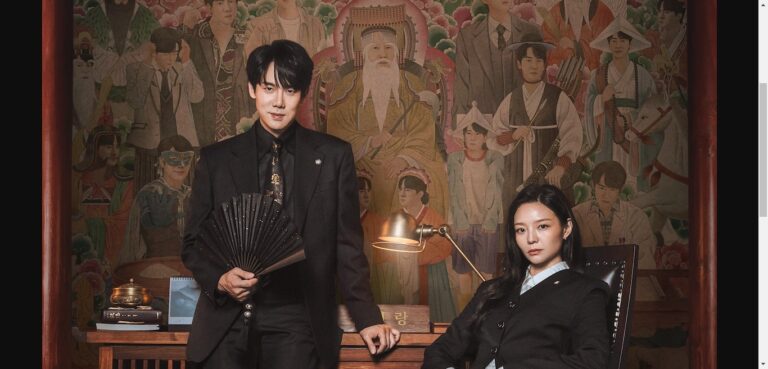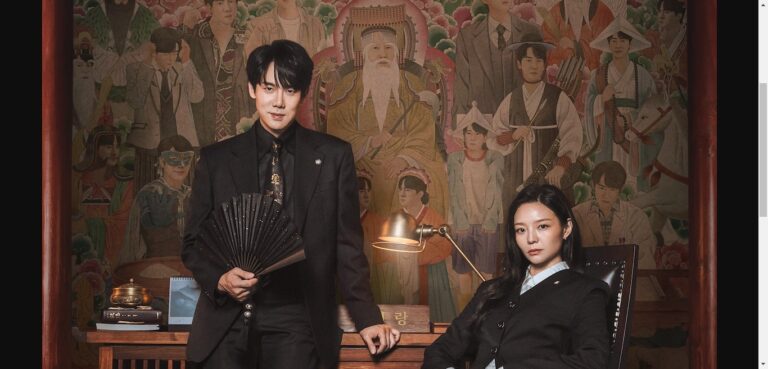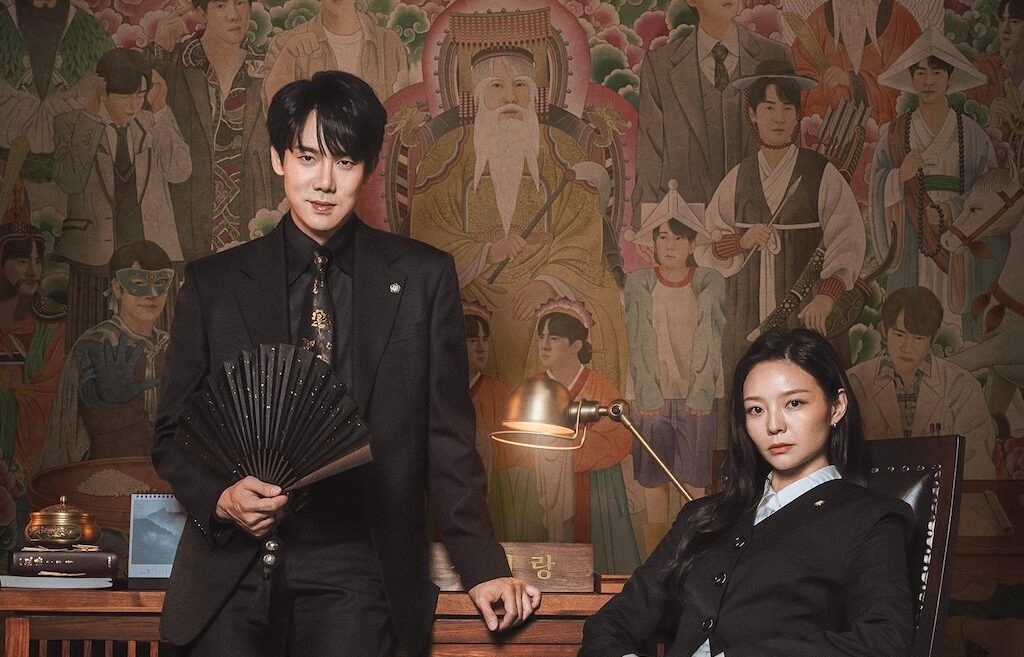
Episode 10 of Phantom Lawyer opens on a slightly awkward but telling note. I-rang walks into his office and immediately assumes the woman waiting for him is a ghost. At this point, that instinct says a lot about how much his world has changed.
Na-hyun arrives soon after and has her own moment of panic, thinking she might have developed the same ability. But the tension breaks when they realize the woman is a real client, Ms. Cha.
What initially feels like a routine consultation slowly unfolds into something heavier. Ms. Cha isn’t just dealing with a legal issue. She’s carrying decades of guilt, and her husband’s sudden appearance as a ghost only makes it impossible to ignore any longer.
From here, the episode shifts into a story rooted in the past, one that quietly builds toward a painful truth.
Ms. Cha takes us back to 1979, when everything started. She was preparing to open a shop using her family’s financial support when she met Kang Dong-sik, a talented shoemaker. Their partnership felt natural, she had the design vision, and he had the craftsmanship.
But they were missing one key piece: a leather supplier. That’s where Seon-hwa entered the picture.
Together, the three of them built Ideal Shoes, a brand that would eventually become widely recognized. On the surface, it’s the kind of origin story that sounds inspiring, three individuals building something meaningful from scratch.
But Phantom Lawyer doesn’t let that image stay untouched for long.
Seon-hwa’s background adds a layer of tension. She was from North Korea and had left her child behind. Despite working hard and supporting her family from afar, she became a target of suspicion. Eventually, she was accused of being a spy.
What makes this part difficult to watch is not just the accusation, but the silence that followed. Ms. Cha and Dong-sik knew the truth, or at least, they knew enough to question it. But they chose not to act.
Their reason? Fear. Speaking up could have destroyed their business and affected many others who depended on it.
So they stayed quiet.
Seon-hwa died in prison, and that silence became something neither of them could ever escape.
Years later, the weight of that decision still lingers. Dong-sik tried to make up for it in the only way he could, by leaving part of his inheritance to Seon-hwa’s son. Eventually, the son, Cha Eung-seong, is found.
But instead of closure, this decision creates conflict within the family.
Kang Ji-hoon, Ms. Cha’s son, challenges the will. From his perspective, honoring it could threaten the company’s stability. He brings in the Taebaek law firm, placing Do-gyeong directly against I-rang and Na-hyun.
What I found interesting here is how the case doesn’t feel purely legal. It feels emotional from every angle. Ji-hoon isn’t entirely wrong for worrying about the company. Ms. Cha isn’t entirely right either. Everyone is acting from a place shaped by the past.
I-rang, as expected, chooses to fight. Not just for the will, but for what it represents. He and Na-hyun begin building a case that recognizes Seon-hwa as a founding member of the business, not just someone who worked behind the scenes.
At the same time, Dong-sik’s condition adds another complication. Before his death, he suffered from severe dementia. As a ghost, his memories are incomplete. He remembers being a shoemaker, but not the people tied to his life.
The way the episode uses shoes as a trigger is a nice touch. It’s simple, but meaningful. Through them, fragments of his identity begin to surface.
One of the things I appreciated most in this episode is how naturally the characters continue to grow.
Na-hyun, in particular, stands out. Earlier in the series, she questioned everything about I-rang’s abilities. Now, after seeing it firsthand, she doesn’t just accept it, she adapts to it.
There’s a scene where she watches him struggle while being possessed, and it clearly affects her. From that point on, her concern feels more grounded. She’s not reacting out of fear anymore, but out of understanding.
Her relationship with I-rang also starts to shift in a subtle way. It’s not overly romantic, but there’s a quiet closeness forming. Small gestures, waiting for him, worrying about him, say more than any dramatic confession could.
I-rang, on the other hand, remains consistent. He’s still stubborn when it comes to doing what he believes is right. Even when a compromise seems easier, he pushes forward.
Then there’s Do-gyeong, who continues to be driven by something much less admirable. His pride and jealousy are still very much intact. Even when given a chance to step away from the case, he refuses.
It’s clear that for him, this is no longer just about work. It’s personal.
But the most layered character in this episode is Ms. Cha.
At first, it’s easy to sympathize with her. She appears to be trying to honor her husband’s final wish while living a modest life as a form of self-punishment. But as the truth comes out, that image begins to crack.
The courtroom scene delivers the kind of twist that changes how you see everything that came before.
Do-gyeong reveals that the will was not created when it claims to have been. It was backdated, written at a time when Dong-sik’s mental state had already declined.
A flashback confirms that Ms. Cha guided him through writing it.
And then comes the revelation that hits the hardest, she was the one who reported Seon-hwa as a spy.
That moment reframes the entire story.
What seemed like shared guilt turns out to be rooted in something more personal. Ms. Cha acted out of jealousy. She believed Dong-sik had feelings for Seon-hwa, and that belief pushed her into making a decision she could never undo.
Since then, everything she’s done, from searching for Seon-hwa’s son to living a simpler life, has been an attempt to cope with that guilt.
What makes this compelling is that the show doesn’t try to excuse her actions, but it also doesn’t reduce her to a one-dimensional villain. She feels like a real person, someone who made a terrible mistake and has been living with it ever since.
Even Dong-sik’s reaction adds another layer. Despite everything, he still tries to defend her when he possesses I-rang. It suggests that his feelings for her never disappeared, even if the past is complicated.
By the end of the episode, the situation feels more uncertain than ever.
If the will is legally invalid, does that erase its meaning? And if it reflects Dong-sik’s true intention, does that make it worth honoring anyway?
There’s also the question of whether Ms. Cha’s actions invalidate her attempt at redemption. Can doing something right later truly balance out something so devastating in the past?
The episode doesn’t answer these questions directly, and that’s what makes it work. It leaves space for interpretation.
Personally, it feels like the story is moving toward emotional closure rather than a clear legal victory. The outcome of the case matters, but not as much as whether the characters can finally face the truth.
Episode 10 feels quieter than some of the earlier episodes, but it carries a heavier emotional weight. It focuses less on dramatic twists and more on the long-term consequences of a single decision.
The pacing allows the story to breathe, even if some revelations come a bit quickly. Still, the emotional payoff is strong enough to leave an impact.
Na-hyun’s growth, I-rang’s determination, and Ms. Cha’s layered story all come together in a way that feels grounded and sincere.
Rating: 8.4/10
A reflective and emotionally driven episode that shows how the past doesn’t simply disappear, it lingers, shapes choices, and eventually demands to be confronted.