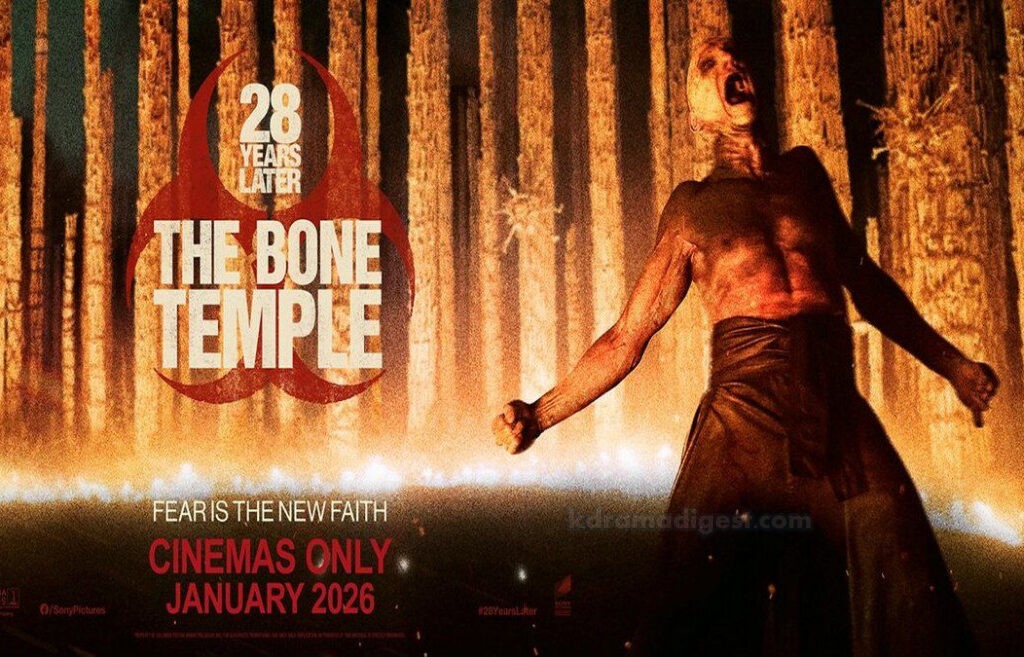
What’s scarier than a zombie?
28 Years Later: The Bone Temple answers that question without raising its voice. It lets the answer rot slowly under the skin instead: human beings, specifically the ones who’ve decided that faith and survival mean the same thing now. This isn’t a film about infected bodies. It’s a film about infected belief systems, and about what happens when desperation, power, and religious delusion collide in a Britain that’s already fallen apart.
Written by Alex Garland and directed by Nia DaCosta, The Bone Temple is the second chapter of the trilogy that began with Danny Boyle’s 28 Years Later last summer, and it makes something clear that the franchise has quietly believed since 2002’s 28 Days Later: the infected have never really been the point. They’re the backdrop. The horror lives in what the uninfected choose to do with each other once the old rules are gone.
Picking Up Where Spike Left Off
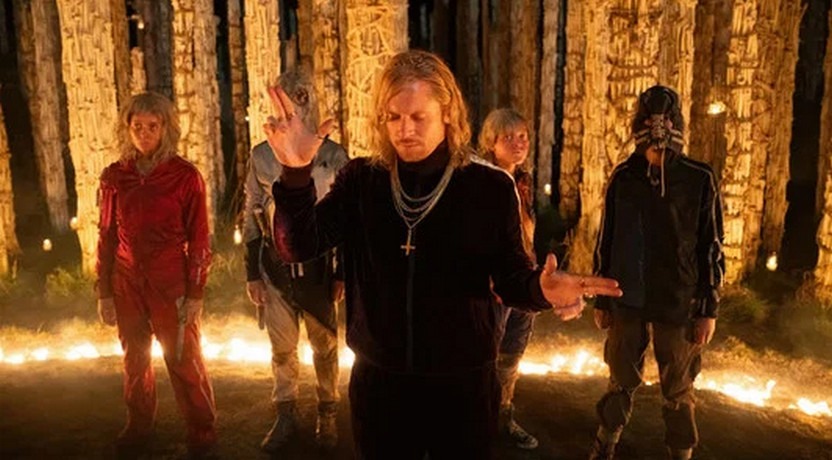
The story continues directly from Spike’s (Alfie Williams) devastating journey to save his mother in the previous film. This time, Spike crosses paths with a gang of Satanist survivors calling themselves the Fingers, led by a man who goes by Sir Lord Jimmy Crystal (Jack O’Connell). Every member of the Fingers takes on a version of their leader’s name, so the man Spike is forced to fight in his initiation is called Jimmy Shite, the one who ends up showing him mercy is Jimmy Ink, and the group’s most vicious member goes by Jimmima. It’s a naming convention built entirely on erasing the individual and replacing him with the cult.
Jimmy Crystal believes he’s a prophet. Not as a metaphor, not as branding. He hears the voice of “Old Nick” in his head and genuinely believes himself to be the devil’s son, a delusion the film traces back to his own childhood trauma in the opening minutes of the first movie. Jack O’Connell plays him with a costume of matching blonde wigs and tracksuits that critics have widely noted echoes the public image of Jimmy Savile, the British broadcaster whose decades of abuse were exposed after his death. It’s a deliberately uncomfortable choice, and the film doesn’t soften it.
The Bone Temple opens with the scene that sets its entire tone: Spike is told that if he wants to survive among the Fingers, he has to kill the man standing in front of him. It isn’t staged for shock value or excess gore. It’s staged so the audience understands, immediately, that in this world belief is proven through violence and acceptance is purchased in blood. There are no speeches justifying it. That’s what makes it land.
Kelson’s Quiet Rebellion Against Despair
On the other side of the story is Dr. Ian Kelson (Ralph Fiennes), a scientist trying to hold onto reason in a world that’s largely abandoned it. Kelson has spent years building an ossuary, the Bone Temple itself, out of the skulls and bones of the dead, while studying an Alpha-class infected he’s named Samson (played by Chi Lewis-Parry). Where earlier films treated the infected purely as a threat to be outrun, Kelson does something the franchise hasn’t tried before: he starts experimenting, sedating Samson with morphine and studying what happens when the Rage Virus’s grip loosens even slightly.
It isn’t played as heroic. It’s played as necessary, maybe even reckless, the last real act of scientific curiosity left in a landscape run by fear and cult logic. When Samson mutters a single, half-remembered word partway through the film, it lands as one of the only moments of genuine hope in the entire runtime, and it’s a testament to how carefully Fiennes plays restraint that the scene doesn’t tip into sentimentality.
A Different Director, a Deliberately Different Look
Following up Danny Boyle was never going to be simple. Boyle reinvented the zombie genre with 28 Days Later and then expanded its scope with 28 Years Later, largely shot on modified iPhones with cinematographer Anthony Dod Mantle. DaCosta, working with cinematographer Sean Bobbitt instead, doesn’t try to replicate that raw, handheld aesthetic. The Bone Temple is visually calmer, more controlled, and it uses that control deliberately: there’s a sequence midway through the film where the camera refuses to show the violence directly at all, relying entirely on sound design and performance, and the restraint makes the eventual reveal hit harder than if it had shown everything upfront.
Structurally, Garland’s screenplay doesn’t try to expand the mythology in new directions. It deepens what’s already there. The Fingers storyline explores how easily people trade their identity for belonging. Kelson’s storyline is the fragile persistence of logic in a world that rewards certainty over doubt. Neither one overpowers the other; they sit in tension for the full 109-minute runtime.
The Performances Carrying It
Ralph Fiennes is doing some of his most controlled work here, balancing exhaustion, dark humor, and grief often within the same scene. Alfie Williams gives Spike a real, unforced vulnerability rather than treating him as a vessel for the plot to move through. And Jack O’Connell’s Jimmy Crystal is unsettling precisely because he isn’t playing a cartoon villain: his conviction that he isn’t evil is what makes him genuinely dangerous. Erin Kellyman, as Jimmy Ink, gives the film’s one meaningfully sympathetic member of the Fingers real weight, largely through what she doesn’t say.
Critics responded to all of it. The Bone Temple currently holds a 92% critics’ score on Rotten Tomatoes, actually higher than the 88% earned by the first film, along with an 88% audience score and a rare A- CinemaScore for a horror release. The consensus that’s emerged across reviews: this is a rare instance of a franchise’s fourth entry being confidently, unmistakably good, even as some viewers found the deliberately subdued climax a letdown after the extreme brutality the Fingers represent for most of the runtime.
A Box Office Stumble That Doesn’t Match the Reviews
Here’s the part that didn’t go the way Sony hoped: despite the acclaim, The Bone Temple underperformed commercially. It opened to roughly $13 million domestically over its January 16, 2026 opening weekend in the US, growing to about $15 million across the four-day Martin Luther King Jr. holiday frame, well under pre-release tracking and less than half of what the first film opened to the previous summer. Against a $63 million production budget and a reported additional $70 million in marketing, the film’s $58.4 million worldwide total left it short of its costs at the theatrical stage. It’s since found a second life on streaming, arriving on Netflix on March 31, 2026, a notably fast turnaround for a Sony release.
What It Sets Up
Without spoiling the film’s final stretch, The Bone Temple ends by quietly reintroducing Cillian Murphy’s Jim, the bicycle courier from the original 28 Days Later, in a move confirmed to be setting up the trilogy’s closing chapter, which Danny Boyle is set to return and direct. It’s not a cliffhanger built on spectacle. It’s a promise that the story isn’t finished, delivered with the same patience the rest of the film has already earned.
28 Years Later: The Bone Temple may not be the most visually aggressive entry in this franchise, but it might be the most unsettling. Its horror doesn’t come from relentless action or excess. It comes from ideas that sit uncomfortably in your chest well after the screen cuts to black. The infected in this world are predictable. The people never are. And that’s exactly what makes it work.