There’s a quiet shift happening in Yumi’s Cells Season 3, and Yumi’s Cells Season 3 Episodes 5-6 make it impossible to ignore. What once felt like a gentle, introspective story about everyday emotions is now leaning into something more volatile, messier, more impulsive, and undeniably more human.
At the center of it all is Soon-rok, a character built on logic, routine, and emotional restraint. Or at least, that’s how he used to be. Because in these two episodes, something begins to fracture. And the most interesting part isn’t just that it happens, but how slowly and unwillingly he loses control.
Meanwhile, Yumi finds herself caught in a familiar but no less complicated situation: trying to stay composed while her emotions quietly spiral underneath. Together, their story in Episodes 5 and 6 becomes less about romance on the surface, and more about what happens when people try, and fail, to suppress what they feel.
Episodes 5-6 Recap (Concise)
Episode 5
Episode 5 opens by highlighting Soon-rok’s “low-power mode” during social situations, especially at a team dinner where his silence makes him seem cold. However, things take a turn when Kim Ju-ho’s behavior starts irritating him. Inside Soon-rok’s Cell Village, small sparks of emotion begin to grow into something bigger.
In an uncharacteristic move, Soon-rok invites Yumi to a movie, something that breaks his own personal rules. The situation quickly becomes awkward when Ju-ho shows up as well, leading Yumi to misunderstand the entire setup. After confronting Ju-ho about his feelings and rejecting him, Yumi also lashes out at Soon-rok before walking away.
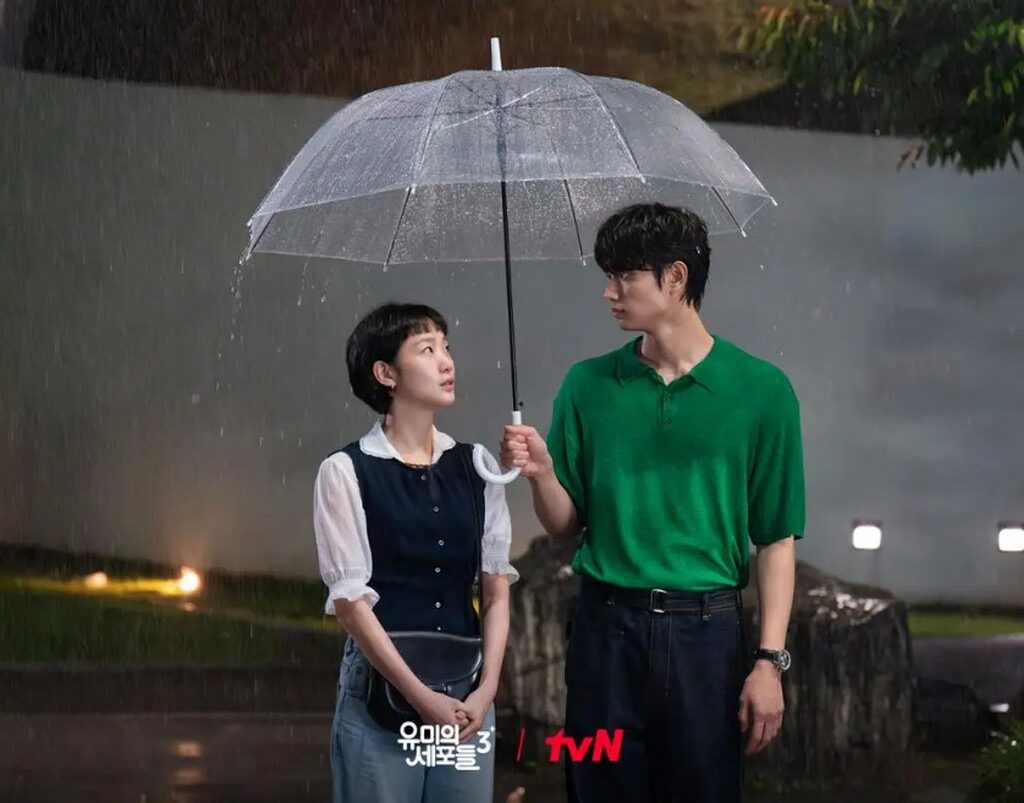
Later, in the rain, Soon-rok goes out of his way to find Yumi an umbrella. Their walk back together is filled with subtle, almost drama-like moments, hinting at a growing connection. However, tensions escalate when Ju-ho confronts Soon-rok about lying.
The next day, it’s revealed that Ju-ho has removed Soon-rok from his team. Feeling guilty, Yumi tries to make things right. When Soon-rok falls ill, she visits him, leading to a quiet but emotionally significant moment that triggers deeper realizations within his Cell Village, especially the possibility that both of them may have feelings for each other.
Still, Soon-rok chooses to distance himself by agreeing to go on a blind date, drawing a clear line between them, at least on the surface.
Episode 6
Episode 6 begins with Yumi channeling her lovesickness into productivity, pouring her emotions into writing. Meanwhile, her internal cells are in conflict, especially after she sets Soon-rok up on a date with her friend, Jenny.
Unable to resist, Yumi secretly observes their date, only to awkwardly insert herself into the situation. Despite appearances, neither Yumi nor Soon-rok seems emotionally settled. Soon-rok continues with the dating plan, but his behavior grows increasingly inconsistent.
One night, he unexpectedly visits Yumi’s studio under the pretense of helping with a gaming console. The quiet, late-night interaction between them is filled with understated intimacy, suggesting that their connection hasn’t faded at all.
Things escalate on the day of Soon-rok’s second date with Jenny. Instead of going through with it, he cancels at the last minute and shows up where Yumi is having dinner, with Ju-ho.
A confrontation between Soon-rok and Ju-ho turns physical, revealing deeper frustrations and exposing Ju-ho’s manipulative tendencies. The fallout leaves everyone shaken.
In the final moments, Soon-rok appears at Yumi’s studio, unable to explain his own actions. But for the first time, he stops resisting the truth, admitting that he might have feelings for her.
Story Analysis: When Control Becomes the Conflict
At its core, Episodes 5–6 revolve around a simple but powerful conflict: control versus emotion.
Soon-rok represents control. He lives by rules, don’t mix work with personal feelings, don’t act impulsively, don’t blur boundaries. These rules aren’t just preferences; they’re defense mechanisms.
But emotions don’t follow rules.
The “sparks” inside his Cell Village are more than just a visual device, they represent the beginning of emotional disruption. What starts as irritation toward Ju-ho gradually morphs into something deeper, something he can’t categorize or suppress.
Yumi, on the other hand, is already familiar with emotional chaos. Her struggle isn’t about recognizing her feelings, it’s about managing them without losing herself. That’s why her reaction at the movie theater and her behavior around Jenny’s date feel so real. She’s trying to stay composed, but her emotions keep leaking through.
The narrative becomes compelling because neither character is fully in control. They’re both reacting, misinterpreting, and protecting themselves in ways that only complicate things further.
And then there’s Ju-ho, a catalyst rather than a true rival. His presence forces both Yumi and Soon-rok to confront feelings they would have otherwise ignored.
Character Development: Cracks Beneath the Surface
Soon-rok: The Slow Collapse of Logic
Soon-rok’s development is the highlight of these episodes.
Up until now, he’s been defined by restraint. But here, we see the cracks forming. He lies. He acts impulsively. He breaks his own rules, first by inviting Yumi to a movie, then by caring about her in ways he can’t rationalize.
What makes this transformation interesting is that it’s not dramatic on the surface. He doesn’t suddenly become expressive or emotional. Instead, his confusion manifests through contradictions. He says one thing, does another, and understands neither.
The moment he cancels his date with Jenny is particularly telling. It’s not just about choosing Yumi, it’s about admitting, even subconsciously, that his carefully constructed logic no longer holds.
Yumi: Between Pride and Vulnerability
Yumi’s journey in these episodes feels quieter but just as layered.
Her Pride Cell plays a bigger role, especially during the café scene with Jenny and Soon-rok. She puts on a confident front, stepping into the role of someone unaffected. But underneath that, her Love Cell is clearly struggling.
What stands out is how Yumi channels her emotions into writing. It’s a coping mechanism, but also a reflection of growth. She’s no longer consumed by her feelings the way she might have been in earlier seasons.
Still, moments like her late-night visit to the studio reveal that she hasn’t fully moved on. She’s trying to stay in control, but not always succeeding.
Ju-ho: From Awkward to Antagonistic
Ju-ho undergoes a more abrupt transformation.
What initially seemed like harmless awkwardness turns into something more problematic. His behavior, especially using gestures like gifting wine as a calculated move, paints him in a less sympathetic light.
While this shift adds tension to the story, it also feels slightly exaggerated compared to the show’s usually grounded tone. Still, his role as a disruptor is effective in pushing the main characters toward confrontation.
Key Moments & Turning Points
Several scenes in Episodes 5-6 subtly reshape the narrative:
- The Movie Invitation: A small decision that breaks Soon-rok’s rules and sets everything in motion.
- The Rain and Umbrella Scene: Classic in structure, but emotionally significant. It’s one of the first moments where their connection feels undeniable.
- The X-Ray Reveal: A metaphorical confirmation that both characters harbor feelings, even if they refuse to acknowledge them.
- The Café Encounter with Jenny: A mix of awkwardness and denial, showing how both characters are avoiding the truth.
- The Late-Night Studio Scene: Quiet, intimate, and arguably more meaningful than any overt confession.
- The Fight Between Soon-rok and Ju-ho: The moment where suppressed emotions finally explode into something physical.
- Soon-rok’s Confession: Not a grant declaration, but a hesitant admission, perfectly in line with his character.
Hidden Meanings / Deeper Insights
One of the most interesting aspects of these episodes is how they portray emotional suppression.
Soon-rok’s “low-power mode” isn’t just a personality quirk, it’s a defense mechanism. By limiting his emotional output, he avoids vulnerability. But the sparks in his Cell Village suggest that emotions don’t disappear, they accumulate.
Yumi’s lovesickness, on the other hand, shows how emotions can be redirected rather than suppressed. She writes more, works more, keeps moving, but the feeling remains.
The use of visual metaphors, the sparks, the X-rays, the struggling cells, continues to be a strength of the series. Even when some elements (like the X-rays) feel slightly out of place, they still serve a purpose: making the invisible visible.
Another subtle theme is timing. Both characters develop feelings, but not in sync. This mismatch creates tension, misunderstandings, and missed opportunities, something the show handles with surprising realism.
What Works and What Doesn’t (Mini Review)
What Works
The biggest strength of these episodes lies in character dynamics. Watching Soon-rok struggle against his own nature is both entertaining and emotionally engaging.
The Cell Village sequences remain a highlight, offering insight into internal conflicts in a way that feels both creative and relatable.
There’s also a natural charm in the smaller moments, the shared umbrella, the late-night gaming session, the quiet glances. These scenes carry more emotional weight than the bigger, more dramatic events.
What Doesn’t
At the same time, the story starts leaning more heavily into K-drama tropes.
The love triangle feels somewhat forced, especially with Jenny’s character lacking depth. Her role exists more as a plot device than a fully realized person, which weakens the emotional stakes.
Ju-ho’s shift into a more overtly negative character also feels slightly exaggerated. It adds drama, but at the cost of the show’s usual nuance.
There’s also a sense that the pacing is a bit rushed. The emotional transitions, especially Soon-rok’s growing feelings, might have felt more impactful with more time to develop.
Predictions: Where Is This Headed?
With Soon-rok finally acknowledging his feelings, the story is likely to shift into more direct emotional territory.
However, that doesn’t mean things will become simple.
Given both characters’ tendencies to overthink and protect themselves, it’s likely that misunderstandings and hesitation will continue to play a role. The question isn’t just whether they’ll get together, but whether they’ll be able to navigate their emotions without retreating into old patterns.
Ju-ho’s conflict with Soon-rok may also have lingering consequences, especially in their professional environment.
Conclusion
Episodes 5-6 of Yumi’s Cells Season 3 mark a turning point, not because of dramatic plot twists, but because of emotional shifts that feel both subtle and significant.
This is where the story stops circling around feelings and starts confronting them, even if reluctantly.
Soon-rok’s quiet confession isn’t just about romance, it’s about the collapse of control, the inevitability of emotion, and the uncomfortable truth that some feelings refuse to be ignored.
And in a series built on the inner workings of the heart, that might be the most honest development of all.
Yumi’s Cells Season 3 Episodes 3-4 | Episode Guides | Yumi’s Cells Season 3 Episodes 7