The Furious (2026) –> Genre: Action / Thriller | Runtime: 105 minutes | Year: 2026
Introduction: More Than Just Another Action Movie
There’s a certain fatigue that sets in when you’ve seen enough action thrillers. The hero loses someone. The villain is menacing but hollow. The fights escalate. The credits roll. You’ve been entertained, and you’ve forgotten it by morning.
The Furious doesn’t let you forget it that easily.
On the surface, it looks like exactly the kind of film you’ve seen before, a missing child, a desperate father, a shadowy criminal operation. But within the first act, something becomes clear: this film has an emotional intelligence that most action movies don’t bother with. It isn’t just about what people are willing to do for the ones they love. It’s about what happens to them while they’re doing it, the grief, the guilt, the rage, and the quiet moments that crack a person open.
This is one of 2026’s best action films, and it earns that distinction not just through its visceral, inventive fight choreography, but through the genuine humanity it places at the center of all that chaos.
The Furious (2026) A Quick Recap: Two Men, One War, Zero Safety Nets
At its core, The Furious tells two parallel stories that eventually collide.
Wang Wei (Xie Miao) is a father whose daughter Rainy is kidnapped in broad daylight by a child trafficking ring. With the authorities either unable or unwilling to help, he goes after her himself, a one-man campaign of controlled fury that leaves a trail of broken bodies and broken systems behind him.
Navin (Joe Taslim) is searching for his wife Matia, a journalist who disappeared while investigating the same trafficking operation. His search is tangled up with guilt, their last conversation ended in an argument, and that unresolved tension haunts every step he takes.
The two men begin as obstacles to each other before becoming reluctant allies. Together, they trace the operation from street-level enforcer Mr Song all the way up to the cold, calculating Paklung, a man who has been using the name and resources of powerful tycoon Kun Tai Luo while secretly running a child trafficking network from the shadows.
The finale takes place during a brutal siege on a police station, where everything converges: the operation, the villains, the vengeance, and the grief. Not everyone makes it out.
Story Analysis: Anger as Architecture
The title isn’t metaphorical decoration, anger is literally the scaffolding this story is built on. Every major character is driven by fury of some kind, whether righteous, corrupted, or somewhere in the painful middle.
What makes the narrative compelling is how the film approaches that fury from multiple angles without ever feeling schematic. Wang Wei’s anger is clean and focused: it belongs to a father who has been failed by the systems that were supposed to protect his child. His violence feels like an extension of love, which is a difficult tonal balance to maintain, and the film manages it.
Navin’s anger is messier, clouded by guilt. He isn’t just searching for Matia, he’s searching for absolution. Their unfinished argument means that even if he finds her, there may be no ending that feels resolved. That tension gives his storyline a tragic undertow the film handles with surprising restraint.
The trafficking narrative itself is well-structured, peeling back layers from street enforcers to a mid-level boss to a shadowy puppet master without ever losing the thread. The revelation that Paklung has been operating under Kun Tai Luo’s name, embedding himself in the man’s family, using his resources, hiding in plain sight, is a genuinely clever piece of plotting. It raises the stakes personally as well as criminally.
Thematically, the film is interested in what family means when it’s weaponized versus when it’s genuine. That contrast, parents who would burn the world down for their children versus a man who treats family as a vehicle for power, gives The Furious a moral architecture that most action films never bother to build.
Character Development: The Ones Who Change and the Ones Who Can’t

Wang Wei: The Father Underneath the Fury
Wang Wei spends most of the film as a near-silent force of nature. He bleeds, he takes hits that would floor anyone else, and he keeps moving. It’s only in the film’s final moments that we understand what all that controlled fury has been protecting: a man who doesn’t yet know how to be a father to the daughter he’s fighting for.
The ending, where Rainy asks him to tell her his story and he begins with “When I met your mother,” is quietly devastating. It signals that the man who spent 105 minutes destroying everything in his path is finally ready to sit still and open up. His arc isn’t about becoming a better fighter, it’s about becoming present again.
Navin: Guilt in Motion
Navin is a more immediately vulnerable character than Wang Wei, and the film uses him to explore a different kind of loss. He doesn’t get the ending he wanted. The discovery of Matia’s ring, and the terrible implication that follows, denies him the closure that Wang Wei eventually finds.
His final moments — passing out with the ring in his trembling hand, whispering “I found her”, are among the film’s most affecting. It’s a man who did everything right, found what he was looking for, and still lost. That’s not a typical action hero arc, and the film is better for it.
Paklung: A Villain Who Almost Gets There
Paklung (Joey Iwanaga) is the film’s most intellectually interesting villain, a man who has constructed an entire false identity around family while running an operation that destroys families. The irony of his final moments, staggering into the rain and begging to see a wife and child who are already gone, lands with genuine weight.
The issue is that the film takes too long to show us who he really is. We don’t get meaningful time with him until over an hour in, which makes his eventual downfall feel slightly under-earned. The bones of a great villain are here. The flesh just needed more time.
Key Moments and Turning Points
The Kidnapping of Rainy sets the entire film’s emotional clock ticking. Its brazenness, broad daylight, no hesitation, immediately establishes that the system that should protect people like Rainy has already failed.
Wang Wei and Navin’s First Collision is where the film’s dual narrative snaps into focus. Two men after the same thing, for different reasons, coming at it from different directions. Their eventual partnership feels earned precisely because they’ve been at odds.
The Revelation of Snake Pit is the narrative’s pivot. What seemed like a localized operation turns out to be far larger and more deeply embedded in legitimate power than anyone realized. This is where the film shifts from a rescue mission to something more like a systemic reckoning.
The Discovery of Matia’s Ring is the film’s emotional gut punch. It reframes Navin’s entire journey in an instant. Every step he took, every injury he sustained, was leading to a moment of loss rather than reunion.
Paklung in the Rain is the film’s most haunting image, a man who built everything on a corrupt idea of family, finally understanding what family means, with nothing left to hold onto.
Hidden Meanings and Deeper Layers
On the surface, The Furious (2026) is a story about two men tearing through a criminal operation. Beneath it, it’s a meditation on what we do with grief, and whether rage is ever a form of love.
Wang Wei’s near-silence throughout is significant. He doesn’t process verbally, he processes physically. His violence is his grief in motion. The film understands that some people don’t grieve with words; they grieve with action. His final decision to sit down with Rainy and tell her a story is the first sign that his grief has found a different channel.
The trafficking operation itself functions as a dark mirror to the theme of family. These children are commodified, moved in refrigeration trucks, treated as cargo. The contrast with the desperate parents searching for them couldn’t be starker. The film is making a quiet argument: that family, real family, is the most dangerous thing a person can have, because it’s also the thing worth burning everything down to protect.
Ho, the film’s physically imposing enforcer, represents another dimension of this. He returns from apparent death not out of greed or orders, but because his father has been killed. He is as grief-driven as Wang Wei and Navin, just pointed in the wrong direction. That parallel is never underlined, but it’s there, and it adds texture to what could have been a standard bruiser role.
What Works and What Doesn’t
The Strengths
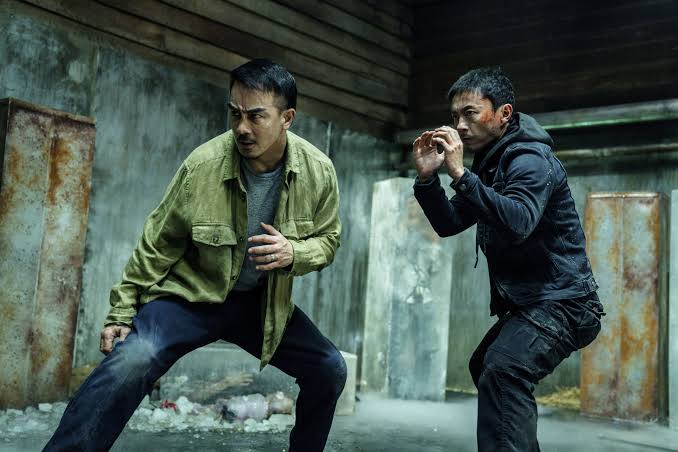
The action choreography is exceptional, genuinely creative and varied. A fight inside a locked octagon, a motorcycle clash in a hallway, and a multi-front finale with moving parts that somehow never lose coherence. Each sequence feels distinct rather than interchangeable, which is harder to achieve than it looks.
The emotional grounding is the film’s real differentiator. The dual protagonist structure pays off because both arcs are given equal weight, and neither ends neatly.
The pacing, though demanding, largely holds. The double finale, two major confrontations in quick succession, is a risk that works better than it should, maintaining momentum rather than exhausting the audience.
The Weaknesses
Paklung is underserved for too long. A villain with this much thematic potential deserved more screen time earlier, and his late introduction leaves his arc feeling compressed.
Similarly, Ho is defined almost entirely by physicality until very near the end. The emotional reason behind his final appearance is affecting, but the film doesn’t quite do the setup work to make it land as hard as it could.
The third act juggles a lot of moving parts simultaneously, and a few supporting characters get lost in the shuffle as a result.
Conclusion: Furious, But Feeling
The Furious (2026) is the kind of action film that shouldn’t work as well as it does. It leans into familiar genre mechanics, the unstoppable protagonist, the shadowy criminal empire, the race against time, but uses them as a delivery system for something genuinely moving.
What lingers isn’t the fights, though the fights are excellent. It’s Wang Wei beginning to tell his daughter about her mother on a quiet beach. It’s Navin’s shaking hand holding a ring that means everything and nothing at once. It’s a villain dying alone in the rain, finally understanding what he destroyed.
The Furious is angry in the way that grief is angry, not senseless, but urgent. And in that urgency, it finds something rare: an action film with a real heart beating underneath all the blood.
The Furious (2026) | Runtime: 105 minutes