Ghost in the Shell is back, and the first episode wastes no time reminding us why this franchise has stuck around since the 90s. From the opening minutes, it’s clear this new series wants to throw viewers straight into its world without holding their hand, for better and for worse. Here’s everything that happens in episode 1, followed by my full breakdown of how well this reboot actually works.
How Episode 1 Opens: A Political Meeting Turns Deadly
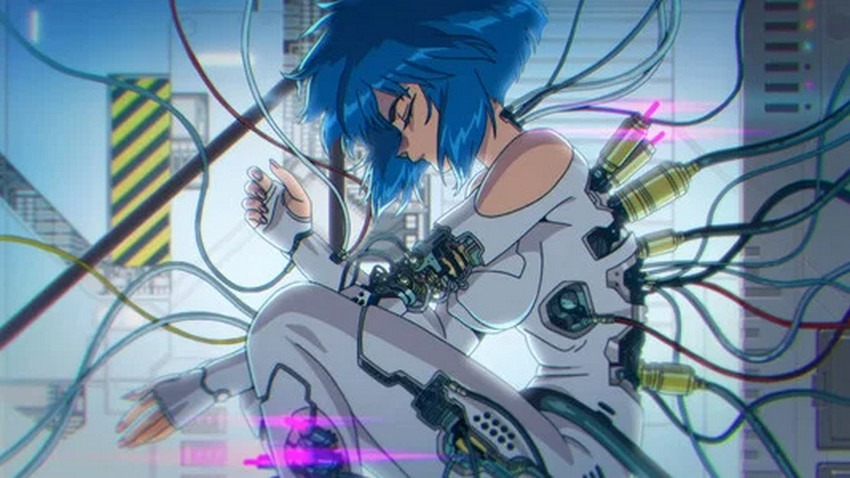
Ghost in the Shell Episode 1 kicks off with police secretly monitoring a tense, shady conversation between the Far East Trade Representative and Japan’s Vice-Minister, along with a handful of other politicians. It’s the kind of backroom meeting that screams trouble from the first frame. But the police aren’t the only ones listening in, a mysterious blue-haired hacker is also tapped into the conversation, watching from the shadows.
When the police finally move in to storm the location, the Representative doesn’t even flinch. He’s confident, almost smug, fully aware that bureaucracy and jurisdiction are working in his favor. He strolls away from the officers like he owns the room, certain he’ll walk out of this without a scratch.
That confidence gets cut short fast. The blue-haired hacker, invisible the entire time, kills him on the spot and disappears just as quickly, but not before letting police chief Aramaki catch a brief glimpse of her. It’s a gut-punch of an opening, and it immediately establishes the kind of ruthless efficiency we’re dealing with here.
Motoko Kusanagi Makes Her Move
Right after the assassination, the hacker reveals her name: Motoko Kusanagi. She heads straight to the Minister of Internal Affairs, presenting her kill order and pitching something bigger, the creation of a special task force. The Minister doesn’t handle this himself, though. He passes the responsibility to Aramaki, setting the wheels in motion for Kusanagi’s new unit.
Not long after, Kusanagi gets the call she’s been waiting for: her proposal was approved. Her squadron is officially a go.
The Sacred Citizen Relief Center Mission
Once the team is assembled, Kusanagi and one of her men link up with an Operator, who briefs them on their first real assignment. The target is the Sacred Citizen Relief Center, which functions as a welfare facility and orphanage on the surface. Underneath that, though, something far darker is happening, the center reportedly has a Ghost Controller and is working on a Ghost key to strengthen its brainwashing capabilities.
Through hacked camera access, Kusanagi’s team gets eyes inside the facility, and what they see is bleak. The children are visibly forcing smiles, putting on a performance of happiness that clearly isn’t real. One boy has his food stolen and, too drained to keep working, ends up tased and dragged off somewhere else. It’s a small moment, but it lands hard, you immediately understand exactly what kind of place this is.
Rattled by what just happened to him, the boy panics and makes a break for it, trying to escape the facility. Kusanagi’s agents move quickly to intercept him and plant a tracking bug, but the center’s own people notice almost immediately and give chase.
The Fuchikoma Chase and the Ghost Controller Twist
This is where things escalate fast. Togusa, one of Kusanagi’s men, tries to make his escape in his Fuchikoma, essentially a futuristic tank, but crashes before he can get clear. When backup arrives to help him, they’re ambushed by Ishikawa, one of their own teammates, who’s suddenly turned hostile.
That’s the moment the team realizes just how real the threat is: the Relief Center genuinely does have someone controlling minds through a Ghost Controller, and they just used it to hijack Ishikawa. Moments later, the same thing happens to Kusanagi herself. The Controller hacks her mind and tries to force her to drive her own tank off a cliff, a genuinely tense sequence that had me holding my breath. She manages to snap out of it just in time to eject and get herself to safety.
Thinking fast, Kusanagi sets up a decoy, letting the Controller believe he’s still got eyes on her while she circles around. The trick works. By the time he realizes what’s happened, it’s already too late, Kusanagi, invisible again, shoots him in both legs and pins him down, demanding he hand over the Ghost key and controller or face the consequences.
A Quiet Moment Before the Mission Wraps
Before everything wraps up, the boy who tried to escape finds Kusanagi and asks her directly if they’re there to save all the children. It’s a simple, heartbreaking question, and her answer is anything but comforting. She tells him no and walks away, saying he needs to build his own future instead of waiting to be rescued. It’s a cold response on paper, but it fits her character perfectly.
Kusanagi’s Reaction to Being Reprimanded
Even though the mission technically succeeds, the Minister isn’t happy. He tells Kusanagi she needs to be more of a team player and criticizes the operation for being too chaotic. Kusanagi doesn’t take that well, she hacks him on the spot and forces him to punch himself in front of everyone. Then she laughs it off, warning that if this is what being a “Public Safety errand girl” looks like, she’ll happily go find another line of work. It’s a sharp, darkly funny way to close out the episode and tells you everything you need to know about who’s really running this show.
My Honest Take: Does This Ghost in the Shell Reboot Actually Work?
I’ll say this upfront, the animation in Ghost in the Shell Episode 1 is genuinely impressive. The trailers and posters promised something visually striking, and episode 1 delivers on that promise completely. There’s a clear effort to bring back that 80s anime and manga energy while still feeling fresh and current, and it mostly succeeds. The action sequences in particular benefit from this style; every movement feels fluid, sharp, and satisfying to watch, especially during the Fuchikoma chase and the final standoff with the Ghost Controller.
Motoko Kusanagi herself is easily the strongest part of this premiere. She’s got presence, confidence, and a ruthless streak that makes her impossible to look away from. Whether she’s calmly walking into a Minister’s office with a kill order in hand or laughing after forcing her boss to punch himself, she commands every scene she’s in. Her supporting cast, Togusa, Ishikawa, Aramaki, doesn’t get nearly as much room to breathe yet, so it’s hard to say much about them beyond “charismatic,” but that’s not necessarily a flaw this early on.
Where the episode stumbles a bit is in how little it explains. This version of Ghost in the Shell drops you straight into its universe with almost zero exposition. What exactly is a “Ghost”? What’s Kusanagi’s squad actually meant to accomplish long-term? What’s the deal with Fuchikomas beyond “futuristic tank”? None of this gets addressed, and while that approach can make a world feel more immersive and lived-in, here it mostly just left me a little lost. For longtime fans of the franchise, this probably won’t matter much. But if you’re coming in fresh, episode 1 might feel more disorienting than intriguing.
Still, as a series opener, it does its job. It sets up a compelling lead character, a genuinely unsettling antagonist force in the Ghost Controller, and a moral gray area around Kusanagi’s methods that I’m curious to see explored further. Whether the show slows down and fills in the blanks in future episodes remains to be seen, but as a first impression, this reboot has more going for it than against it.
Next: Ghost in the Shell Episode 2