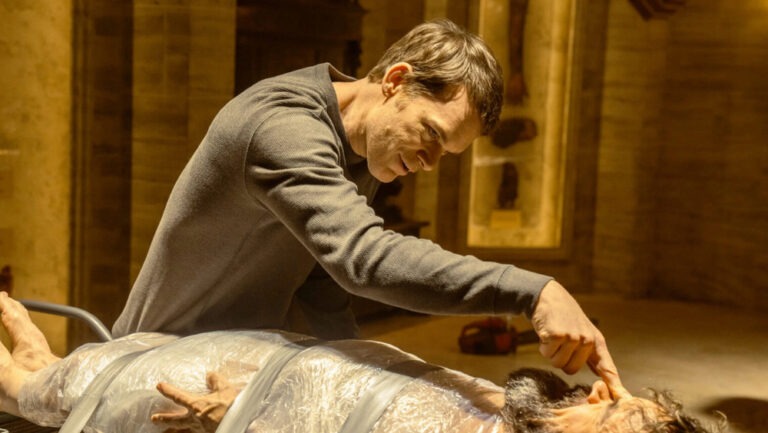
Paramount+ with Showtime Series · Spoiler warning: this article covers all ten episodes, Dexter: Resurrection Season 1.
Dexter Morgan was supposed to be finished. He took a hunting rifle round to the chest from his own son at the end of New Blood, and most of us accepted that as the closing line of the story. Dexter: Resurrection Season 1 doesn’t accept it at all. The series premiered on July 11, 2025 on Paramount+ with Showtime, ran ten episodes, and picks up ten weeks after the shooting with Dexter waking up from a coma and chasing his missing son to New York City. Once he gets there, the show turns into something I didn’t expect: part father-and-son repair job, part serial killer social club, and part slow-motion trap closing in around a man who has been lucky for twenty years.
With Season 2 arriving on October 30, 2026, this is the full season in order, plus what I think worked, what didn’t, and who matters most.
Episodes 1-10 Recap
Episode 1 – “A Beating Heart…”: Harrison Morgan, now a bellhop at the Empire Hotel in Manhattan, gives in to his own dark side and kills Ryan Foster, a guest who was trying to assault a drugged woman. Back in upstate New York, Dexter wakes from a ten-week coma, haunted by visions of people from his past who kept telling him to keep living. Teddy Reed and Angel Batista visit his hospital room with news: Angela Bishop has withdrawn her accusation that Dexter was the Bay Harbor Butcher, and the deaths of Matt Caldwell and Logan have been explained away. Batista isn’t buying any of it, and he gets Dexter legally declared alive. Then Dexter hears the details of the Ryan Foster killing, recognizes his own lessons in it and understands his son did it. Weak and in pain, he walks out of the hospital and heads for New York.
Episode 2 – “Camera Shy”
Dexter studies the hotel crime scene and quietly cleans up the blood spatter Harrison missed. Harry, his Dark Passenger in the shape of his late adoptive father, pushes him to guide his son, but Dexter would rather protect Harrison from a distance than turn his life upside down. He takes back his real name, rents an apartment, buys a car and meets Blessing Kamara, a UrCar rideshare driver. Through Blessing he hears about a killer called the Dark Passenger who targets rideshare drivers and identifies him as Ronald “Red” Schmidt. Then comes the first sign that this Dexter is different: he saves Red’s next victim instead of taking the kill. Meanwhile, Angel starts looking for Dexter with Teddy’s help, and Harrison, haunted by what he did, sells Dexter’s old truck.
Episode 3 – “Backseat Driver”
Dexter’s first days as a rideshare driver go badly until Blessing helps him fix them. Blessing’s daughter Joy gives him acupuncture, which restores some of his strength, and he orders new kill tools online. Angel learns from Teddy that Dexter is in New York and tells Joey Quinn and Vince Masuka he’s retiring from the force to chase it. Harrison grows closer to his coworker Elsa, becomes the prime suspect in Foster’s murder and avoids confessing by revealing that he’s been sleeping in empty hotel rooms with Elsa’s help, which gives him an alibi. Dexter sets himself up as Red’s next target, learns that Red’s cab-driver father lost his job to rideshare apps and took his own life, and just before the kill hears that Red was invited to a dinner party for serial killers. Dexter decides to go in his place.
Episode 4 – “Call Me Red”
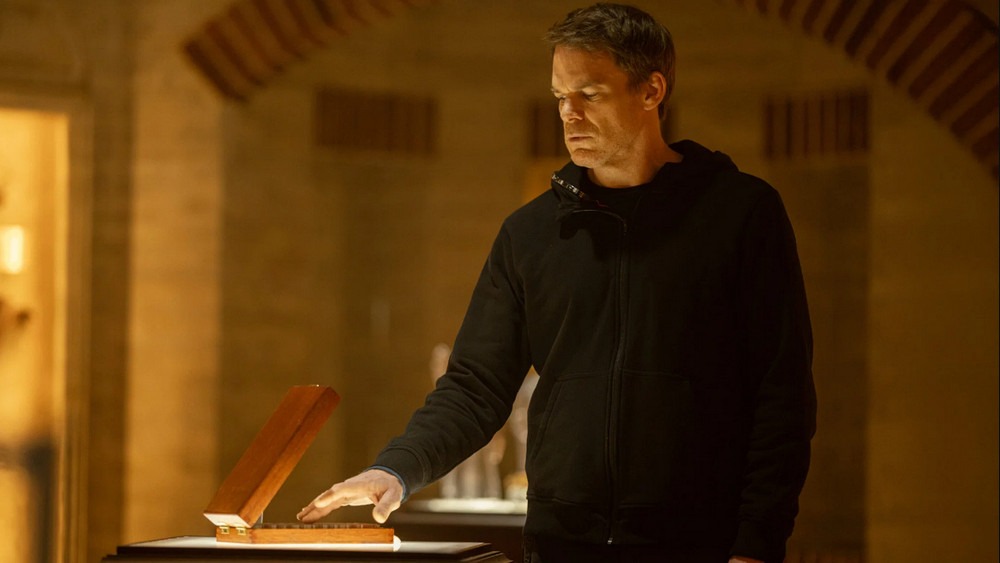
Posing as Red, Dexter meets billionaire venture capitalist Leon Prater, who runs a secret society of serial killers and keeps a trophy collection that includes items tied to Arthur Mitchell, Brian Moser and, without knowing it, Dexter himself. The other guests are Al, Lowell, Gareth and Mia LaPierre. Dexter bonds with Mia, who goes after sexual predators who escape justice after her young sister was raped. He kills Lowell to save his next victim and, inspired by Prater’s collection, starts keeping blood slides again. Angel arrives in New York and tries to get Harrison to talk. Harrison nearly turns himself in at the police station after Elsa rejects his attempt to kiss her, and Dexter finally reveals himself to stop him.
Episode 5 – “Murder Horny”
Father and son talk for the first time. Harrison admits his guilt and tells Dexter that Batista is hunting him, though he isn’t sure he wants his father back in his life. Dexter keeps seeing Mia and thinks about telling her the truth about who he is. Then she suggests they kill someone together and he realizes she has no code at all, and that she’ll kill whoever is in front of her when the need hits. Dexter can’t kill her without drawing attention, so he has her arrested as she’s about to attack her next victim and frames her for Foster’s murder. Prater tells Charley to deal with Mia. Dexter ends the episode by promising Harrison he’ll stop trying to shape him in his own image.
Episode 6 – “Cats and Mouse”
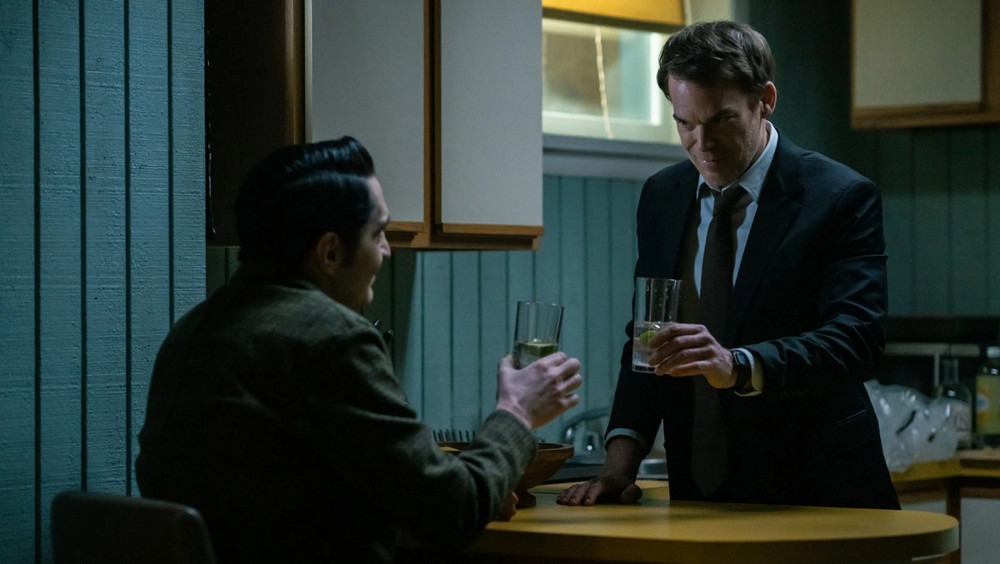
Dexter and Harrison attend the wake of Blessing’s mother, Prudence, and Blessing opens up about being a child soldier for the Revolutionary United Front. Harrison considers applying to NYU, and while babysitting for Elsa he is shaken by a fantasy of killing her neglectful landlord, Vinny. Angel tells Detectives Wallace and Oliva what he suspects about Dexter and Harrison, but before they can question Mia, Charley bribes a prison guard to kill her and stage it as a suicide. Dexter goes after Gareth, the Gemini Killer, lets Gareth follow him home and poisons his drink with M99 before killing him. Prater then invites Dexter on a trip with the group, and as Dexter walks toward the helicopter, Gareth walks up and boards it. The Gemini Killer was a pair of identical twins all along.
Episode 7 – “Course Correction”
Prater takes his killers to a rented castle, where Dexter, still playing Red, talks about his true self in half-cryptic terms. Prater, moved by it, opens up about his own childhood and his friendship with the man who murdered his parents. Dexter tells the surviving Gemini twin that he killed his brother, the twin attacks, and Dexter kills him and frames it as self-defense, also pinning Lowell’s death on him. Back in the city, Dexter takes Harrison to visit a college, where they attend a lecture by Detective Wallace on the New York Ripper, an unidentified killer she never caught. Dexter noticed the Ripper’s weapon in Prater’s collection and offers Wallace some advice. Angel turns up at Blessing’s house looking for Dexter, who offers him a ride, warns him to stay away from his son and throws him out of the car. Angel quietly leaves his AirPods in the door as a tracker.
Episode 8 – “The Kill Room Where It Happens”
Charley starts digging into Dexter. He sets out to kill Al, but Al decides to go home to Wisconsin early. Dexter’s attempt to help Blessing and Joy backfires when he tells Joy that her father was a child soldier, breaking Blessing’s trust. Harrison applies to college and spends the night with a new friend, Gigi. With Elsa’s situation getting worse, Dexter kidnaps Vinny, takes him to his kill room in a wig shop, scares him into treating his tenants better and lets him go. Angel, following the AirPods, finds the kill room, but Dexter escapes and destroys the tracker. With no evidence and several laws broken along the way, Angel loses credibility with Wallace and Oliva, and Wallace learns from Quinn that he has already left the police force. The episode ends at dinner, when Prater walks up to Dexter and Harrison, having just learned that Harrison exists.
Episode 9 – “Touched by an Ángel”

Dexter hustles Harrison out of the restaurant and explains everything. Charley corners Harrison, who gives her a version of the truth, so Dexter finds her in her car and puts her in a chokehold. He lets go when she tells him that working for Prater is the only way she can pay for her mother’s cancer treatments. Angel has lost his police access, so he goes straight to Prater and tells him who Dexter really is. Prater calls Dexter to his vault and offers to be his benefactor if he kills Angel. Dexter cuts Angel loose instead, Angel attacks him in a rage and Prater shoots Angel and locks Dexter in the vault. Dexter confesses he was the Bay Harbor Butcher but swears he didn’t kill James Doakes or María LaGuerta. Angel dies cursing Dexter’s name.
Episode 10 – “And Justice for All…” (Finale)
Trapped in the vault with Angel’s body, Dexter hallucinates his brother Brian Moser mocking him for getting attached to people. A call from Quinn helps Dexter find Angel’s phone, and he calls Harrison, who sneaks into Prater’s gala as a waiter. Charley catches him, but Dexter shows her through the phone that Prater keeps a file on her, including the fact that she had Mia killed. She lets Harrison go, quits and warns Prater to keep paying for her mother’s care. Dexter works out that the vault code is the inmate number of the man who murdered Prater’s parents, since the gala falls on the anniversary of their deaths. Harrison opens the vault, and Dexter grabs files, his blood slides and Red’s thumbprint. Prater catches Harrison and plans to kill both of them, but Harrison injects him with the M99 Dexter gave him. Dexter ties Prater to the table, tells him the Morgan family has its own sense of justice and kills him. He triggers the alarm on his way out, so police find Angel’s body, a gun with Prater’s fingerprints and the file naming the New York Ripper as Don Framt. Charley drives off with her mother, and Dexter dumps Prater’s body in the harbor and heads out to sea on Prater’s yacht with the files.
Want the full breakdown of the finale? Read our Dexter: Resurrection Season 1 ending explained.
A Revival That Finally Knows What It’s About
The big question hanging over this season was simple: why bring Dexter back at all? New Blood ended with a death that felt final, and early critical reactions were split between people who thought the revival was unnecessary and people who enjoyed the return of the thrill. I’ll be honest, I was in the first camp for about two episodes. The answer the show gives is that Dexter is no longer the lonely man at the center of every story. Season 1 is built around two relationships, his son and his old friend, and both are about what happens when a killer is seen by people who love him.
That’s what makes the Prater club such a clever device. For years Dexter’s biggest secret was that nobody else could understand him. Sitting at a table with Al, Lowell, Gareth and Mia, he finally meets people like him, and he hates it. Every one of them is a reminder of what he would be without Harry’s code. The season keeps asking the same question in different ways: if you finally find your people and they’re monsters, what does that say about you?
Everyone Is Watching Dexter
Dexter Morgan is a gentler, more tired version of the character, and I think that’s the smartest choice the writers made. He saves Red’s victim in Episode 2, spares Charley in Episode 9, and spends half the season trying to stop Harrison from copying him. By the finale he’s still a killer, but he admits that his sense of justice comes from the Morgan family as much as from the Dark Passenger.
Harrison Morgan is the season’s emotional engine. He’s no longer a teenager running from his father, he’s a young man dealing with a murder he can’t undo. His guilt, his nearly-confessing moment in Episode 4 and the fantasy about Vinny in Episode 6 all point in the same direction, and the finale rewards that arc when he’s the one who saves Dexter. The M99 syringe in his pocket is a quiet bit of payoff.
Angel Batista is the season’s tragic figure. He’s right about almost everything and still loses everything. He quits the force, breaks laws and burns his credibility chasing a friend he can’t stop thinking of as a friend. When he dies calling Dexter out, the moment lands harder because the show spent nine episodes making us understand him.
Leon Prater is the best kind of rich villain, one who thinks he’s a patron of the arts. He collects killers the way other billionaires collect paintings, and his big mistake is wanting to get close to the real thing. By the end he’s feeling the urge himself, and he gets exactly what he wished for.
Charley Brown is the most interesting person in his orbit. She vets killers, handles problems and keeps a lid on everything, all to pay for her mother’s treatments. Her arc from Prater’s most loyal fixer to the person who walks out on him feels earned, and she’s the one character who leaves the season with her life intact.
Mia LaPierre is the season’s most tragic misdirection. For a few episodes she seems to be Dexter’s equal, a killer with a code, and the show lets us enjoy the bond before revealing that she has no code at all. Her death, staged as a suicide in prison, suits how little Prater’s world cares about people it’s finished with.
Blessing Kamara is the warmest presence in the show. He gives Dexter a basement apartment, a job and something close to friendship without ever knowing who he is. His backstory as a child soldier gives the series an unexpected emotional center, and Dexter’s betrayal of that confidence in Episode 8 is one of his smallest and most believable mistakes.
Claudette Wallace and Melvin Oliva are the competent police presence the show needed. They aren’t fooled, but they aren’t ahead of Dexter either, and they both survive the season with a name, Don Framt, that gives them a path to the Ripper.
Harry Morgan and Brian Moser both appear in Dexter’s head. Harry pushes him toward fatherhood and restraint, while Brian, who shows up in the vault, pushes him back toward the old, isolated version of himself. Watching them argue over Dexter’s choices is the season’s best use of nostalgia.
The club members – Lowell, Gareth and Al each get a distinct personality and a distinct end. Lowell is the first to fall, Gareth turns out to be two people, and Al leaves for Wisconsin before Dexter can get to him, which makes him the only member of the group still alive.
Key Moments & Turning Points
- Dexter walks out of the hospital (Episode 1): The comeback starts with a man too weak to run and too stubborn to stay.
- Saving Red’s victim (Episode 2): The first sign that this Dexter is not the one from the old days.
- Prater’s dinner (Episode 4): Dexter meets killers who aren’t like him at all.
- Mia’s arrest (Episode 5): The first time Dexter frames someone close to him.
- The Gemini twist (Episode 6): The show’s cleverest trick, and the best villain reveal in years.
- The AirPods (Episode 7): A tiny prop that nearly ends the whole game.
- Angel in the vault (Episode 9): The friend finally lands the punch, and dies for it.
- Harrison’s syringe (Episode 10): The son saves the father with a gift the father didn’t plan on using.
Hidden Meanings & Deeper Insights
The most interesting choice is how the season treats secrets. Almost every major character is hiding something from someone else: Harrison hides Foster’s murder, Dexter hides his identity, Charley hides what Prater really does and Angel hides that he quit the force. The only person who finally gets to say everything out loud is Dexter, and he does it in a sealed vault with a dying friend.
The other detail I keep thinking about is how often parents shape the story. Harry gave Dexter his code, Dexter is trying (and failing) to avoid giving it to Harrison, Charley is working for her mother, Blessing is trying to protect Joy from his past and Prater is shaped by the death of his parents. The whole season is about what we inherit from the people who raised us, and whether we can choose differently.
What Works and What Doesn’t
What works: The ensemble is strong, especially Peter Dinklage, Uma Thurman and David Zayas. The Prater club gives the season a clear structure, with one killer to remove at a time, and the Gemini reveal is a genuine surprise. The father-and-son material gives the revival a reason to exist, and critics have been kind overall, with Rotten Tomatoes reporting a 95% approval rating from 63 critic reviews.
What doesn’t: The finale is a little too tidy. Prater is dead, Angel’s death is blamed on him and Dexter sails off with a stack of new targets, which feels like an ending designed to be safe. Mia’s exit is rushed, Harrison’s college subplot goes nowhere and Wallace and Oliva stay a step behind for most of the season. The franchise-callback cameos are fun, but a few of them feel like they’re there for the sake of it, which is also what some reviewers pointed to when they questioned whether a revival was needed. Metacritic’s score of 65 reflects that split.
Conclusion
Dexter: Resurrection Season 1 turns out to be more than a victory lap. It takes a character who spent two decades in isolation and puts him between a son who needs him and a friend who won’t let him go, and it shows the cost of that on screen. The season drew 3.1 million global viewers across its first three days, won the Saturn Award for Best Thriller Television Series and was renewed in October 2025. Season 2 premieres October 30, 2026 with Brian Cox as the New York Ripper and Dan Stevens as the Five Borough Killer, Charley returning, and Dexter dealing with something he’s never faced: a midlife crisis. After this season, I’m in.