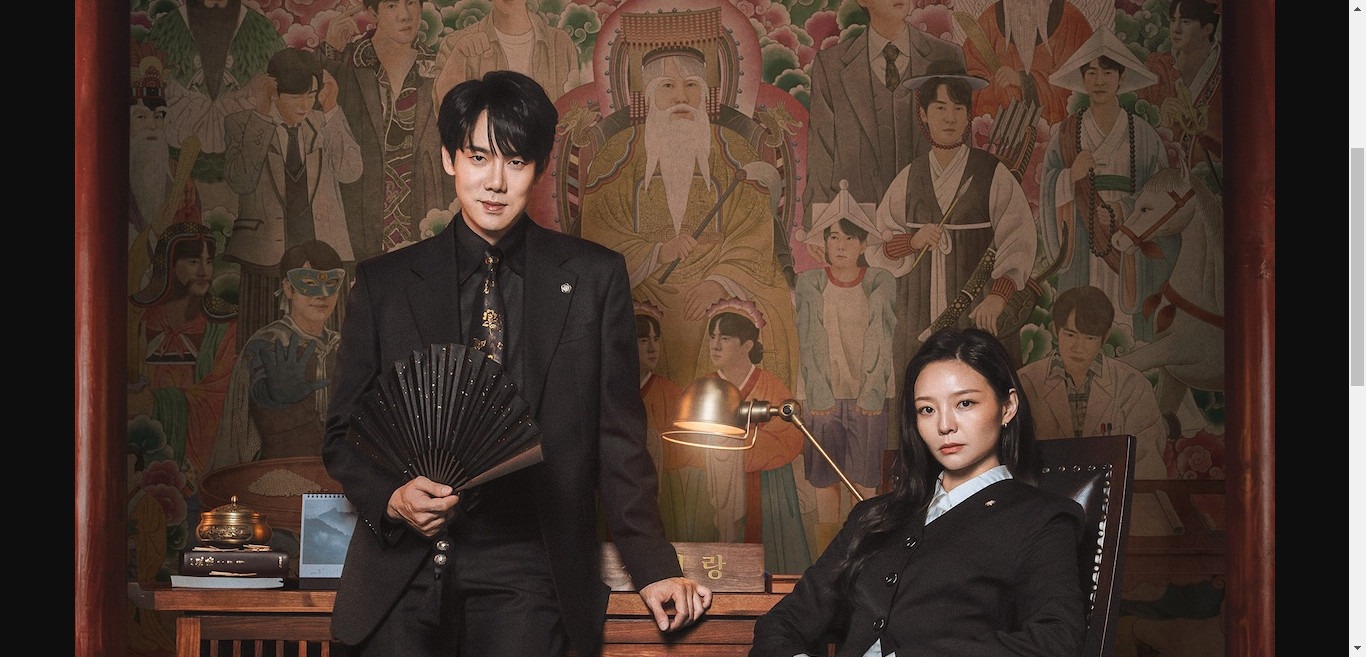
Episode 10 of Phantom Lawyer opens with a moment that perfectly captures the show’s unique tone, half legal drama, half supernatural mystery. I-rang arrives at his office, now shared with Na-hyun, only to find a woman waiting. His first instinct? She must be a ghost.
It’s a small but telling detail. By now, I-rang’s life has become so entangled with spirits that the line between the living and the dead feels almost irrelevant. Na-hyun, still adjusting to this strange reality, panics when she sees the woman too, only for both of them to realize she’s very much alive.
The woman introduces herself as Ms. Cha, and her story quickly sets the emotional foundation for the episode. Her husband, Kang Dong-sik, has appeared as a ghost. But unlike other cases, this one is deeply rooted in decades of regret, love, and a past that refuses to stay buried.
What begins as a legal consultation soon unfolds into something far more personal, a story that stretches back to 1979, when ambition, friendship, and quiet jealousy first collided.
A Story Built on Shoes, Dreams, and Silent Betrayal
Ms. Cha recounts how she met her husband years ago, when she was preparing to start a business using her marriage funds. Dong-sik, a skilled shoemaker, became her partner. Together with Seon-hwa, a leather supplier, they built what would eventually become Ideal Shoes, a successful and beloved brand.
At first glance, it sounds like a classic success story. Three people, each bringing something essential to the table, building a legacy from nothing. But Phantom Lawyer is never interested in simple narratives.
Seon-hwa’s past complicates everything. A defector from North Korea, she lived with the constant burden of being separated from her child. She worked hard, sent money back home, and tried to build a new life, until she was accused of being a spy.
What follows is the kind of moral dilemma that defines this episode. Ms. Cha and Dong-sik knew the accusation was unjust. But they stayed silent. Speaking up could have destroyed their business and affected the livelihoods of many others. So they chose survival over justice.
Seon-hwa died in prison.
That single decision, one moment of silence, becomes the emotional core of the episode. Everything that follows is shaped by that guilt.
Years later, unable to escape what they had done, the couple tried to find Seon-hwa’s son. Dong-sik even left part of his inheritance to him in his will. Eventually, the son, Cha Eung-seong, is found.
But instead of closure, this discovery opens a new conflict.
A Legal Battle That Reveals More Than It Hides
The case takes shape when Kang Ji-hoon, Ms. Cha’s son, challenges his father’s will. Represented by the powerful Taebaek firm, the opposition brings in Do-gyeong, whose complicated relationship with I-rang and Na-hyun adds another layer of tension.
On the surface, the case is about inheritance. But underneath, it’s about legitimacy, truth, and whether guilt can ever be resolved through money.
I-rang and Na-hyun focus on proving that Seon-hwa was not just an employee, but a founding member of Ideal Shoes, someone who rightfully deserves recognition, even posthumously through her son.
Meanwhile, Dong-sik’s ghost complicates matters further. Before his death, he suffered from severe dementia. As a spirit, he remembers fragments, his identity as a shoemaker, his instincts, his craftsmanship, but not his wife.
His memories are triggered by shoes. It’s a subtle but poetic detail. Shoes, the very foundation of his life’s work, become the key to unlocking his past.
When he possesses I-rang, the story takes on a more urgent, almost chaotic energy. He wanders through familiar places that are no longer the same, searching for something he can’t fully remember. A workshop replaced by a different shop. Streets that feel both known and foreign.
These scenes are some of the most quietly devastating in the episode. They show not just memory loss, but the disorientation of time itself, how the world moves on, even when someone is left behind.
Na-hyun’s role becomes increasingly important here. She sees firsthand how vulnerable I-rang is when possessed. Her concern shifts from skepticism to genuine care. When she finds him sitting alone, lost and defeated, her response is simple but meaningful, she stays.
That emotional shift marks a turning point in their relationship.
The People Behind the Case
This episode does a strong job of deepening its core characters without losing focus on the case.
I-rang remains driven, almost stubbornly so. Even when Na-hyun suggests settling, he refuses. For him, this isn’t just about winning, it’s about doing what feels right, even if the truth is complicated.
Na-hyun, on the other hand, evolves significantly. She’s no longer just reacting to I-rang’s supernatural abilities. She understands them now, and more importantly, she chooses to stand by him. Her support feels grounded, not dramatic. It shows in small actions, waiting, searching, worrying.
Their dynamic begins to shift subtly. There’s a quiet emotional undercurrent, a sense that their partnership is becoming something more, though the show wisely keeps it understated.
Then there’s Do-gyeong.
His motivations are less noble. Jealousy, pride, and unresolved feelings continue to drive him. Even when Chairman Yang doubts his ability to handle the case, he insists on taking it. Not because it’s the right move, but because he refuses to step back.
This makes him an effective foil to I-rang. Where I-rang is guided by principle, Do-gyeong is guided by ego.
But the most complex character in this episode is Ms. Cha.
At first, she appears as a grieving widow trying to honor her husband’s final wishes. But as the courtroom scene unfolds, the truth emerges, and it changes everything.
A Truth That Rewrites Everything
The courtroom sequence delivers the episode’s biggest twist.
Do-gyeong reveals that the will was backdated. It was supposedly written in 2019, but in reality, it was created in 2022, when Dong-sik’s dementia had already worsened. The implication is clear: the will may have been manipulated.
A flashback confirms it. Ms. Cha dictated the contents to her husband.
And then comes the most devastating revelation, she was the one who reported Seon-hwa as a spy.
What once seemed like a story of shared guilt becomes something more personal, more painful. Her actions weren’t just driven by fear. They were driven by jealousy.
She believed Dong-sik loved Seon-hwa.
That belief, whether true or not, led her to make a decision that destroyed another person’s life. And she has been living with that guilt ever since.
This is where Phantom Lawyer excels. It doesn’t present its characters as purely good or bad. Ms. Cha is not reduced to a villain. She is someone who made a terrible choice and has been trying, imperfectly, to make amends.
Even Dong-sik’s ghost reflects this complexity. Despite everything, he still tries to protect her. Even in death, his instinct is to shield, not accuse.
The episode ends on a tense note. Possessed by Dong-sik, I-rang insists that he wrote the will himself. It’s unclear whether this is truth, denial, or something in between.
What is clear is that the past is no longer hidden. And the consequences are finally catching up.
Interpreting the Ending and What It Might Mean
The ambiguity surrounding the will raises an important question: does intention matter more than accuracy?
Even if the will was technically manipulated, it reflects something real, Dong-sik’s desire to atone, to acknowledge Seon-hwa’s role, and to make things right for her son.
At the same time, Ms. Cha’s actions complicate that intention. Her guilt drove her to act, but it also led her to cross ethical lines again.
There’s also the emotional question of memory. Dong-sik’s fragmented recollections suggest that truth isn’t always clear, even to those who lived it. His recognition of Ms. Cha near the end hints at lingering love, but it doesn’t erase the past.
Looking ahead, the case seems less about legal victory and more about emotional resolution. Whether the court validates the will or not, the real outcome lies in whether these characters can confront what they’ve done, and accept it.
Final Thoughts and Rating
Episode 10 stands out as one of the more emotionally layered chapters of Phantom Lawyer. It balances its legal storyline with deeply personal themes, guilt, jealousy, memory, and the long shadow of past decisions.
Na-hyun’s growth is particularly notable. Her transition from skeptic to ally feels natural and well-earned. Meanwhile, the tension between I-rang and Do-gyeong continues to build, setting the stage for a larger confrontation.
The case itself is compelling, not because of its legal complexity, but because of its emotional weight. It asks difficult questions without offering easy answers.
If there’s a weakness, it’s that some revelations arrive quickly, leaving little room to fully explore their impact. But the emotional core remains strong enough to carry the episode.
Rating: 8.5/10
A thoughtful and quietly powerful episode that reminds us how one decision, made in fear or jealousy, can echo across a lifetime, and even beyond it.