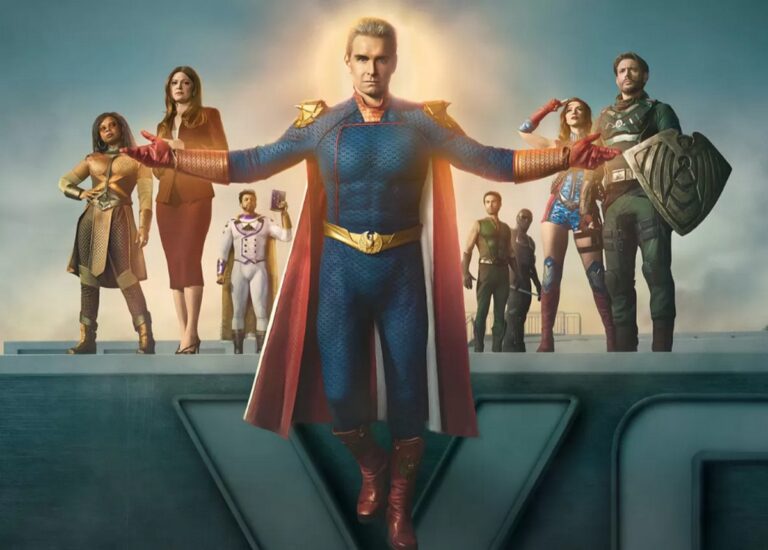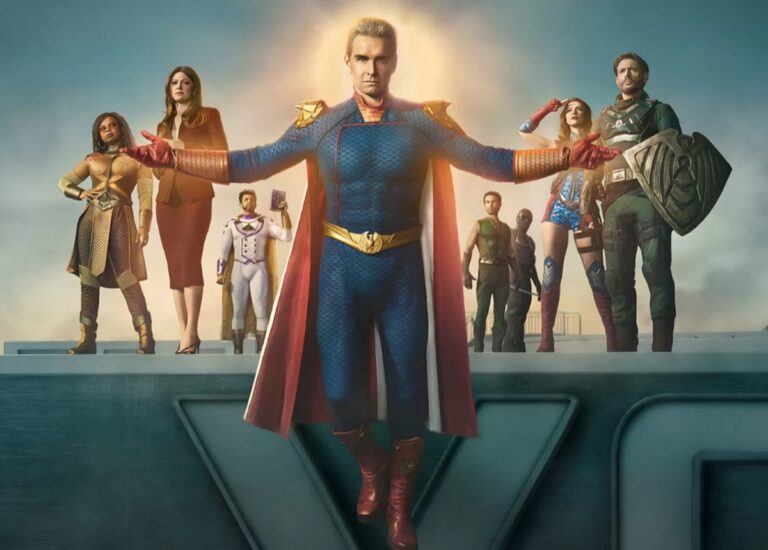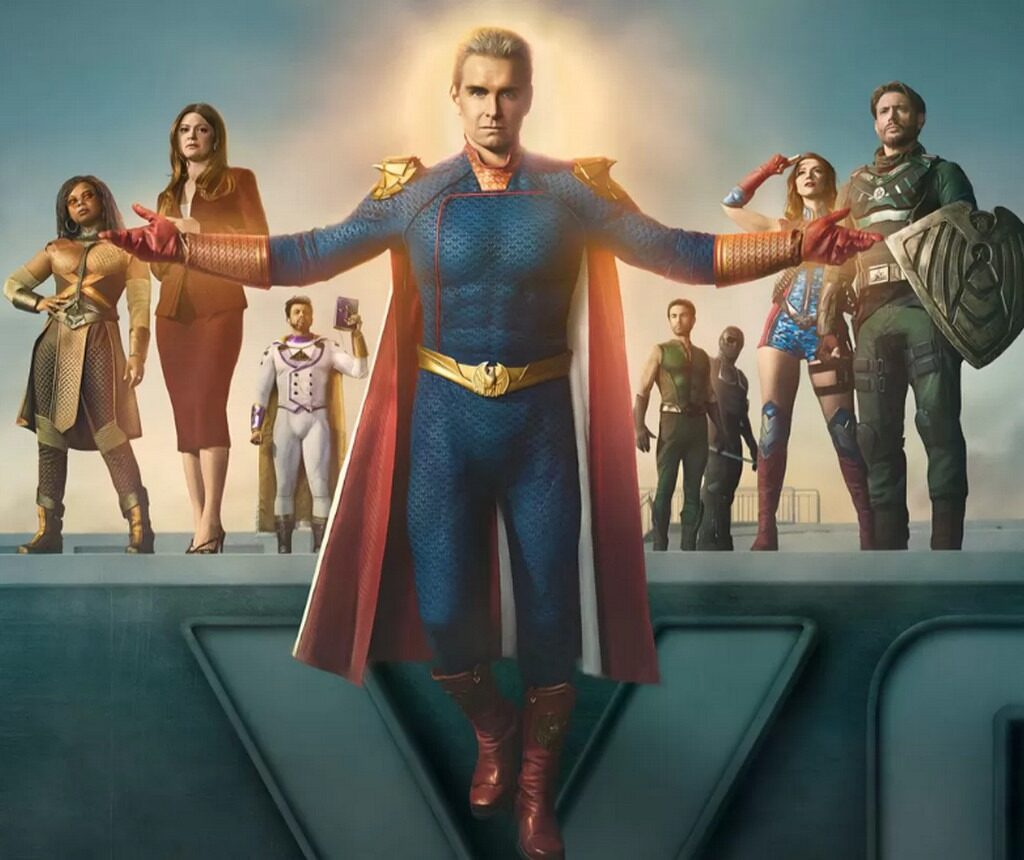
This The Boys Season 5 Episodes 1-4 recap doesn’t just break down what happened, it explores why everything feels heavier this time.
I’ve followed The Boys long enough to know what it usually does best, shock, satire, and chaos wrapped in superhero skin. But Season 5 feels different. Not louder. Not bigger. Just… heavier.
Episodes 1-4 don’t just escalate the conflict. They quietly shift the focus from spectacle to consequence. And somewhere along the way, the question changes. It’s no longer “Who’s the villain?”
It becomes: What happens when everyone starts justifying the same kind of damage?
The Boys Season 5 Episodes 1-4 Recap
Episode 1: Control the Narrative, Control the World
A year after Season 4, the world has moved on, but not in a good way.
Starlight supporters are now labeled terrorists and locked in Freedom Camps. Annie’s attempt to expose Homelander backfires almost instantly, buried under propaganda and digital manipulation.
The rescue mission becomes a trap.
The escape becomes a mess.
And A-Train’s death becomes the emotional core of the episode.
Not shocking, just inevitable.
Episode 2: The Virus Changes Everything
The introduction of the supe-killing virus shifts the story into moral gray territory.
Butcher sees it as the only logical solution.
Hughie and Kimiko see the risk.
And for the first time, the conflict inside the group feels more dangerous than the one outside.
Episode 3: Plans Fall Apart, Fast
Every plan collapses almost as soon as it begins.
Soldier Boy turns out to be immune.
Ryan becomes central, but also vulnerable.
And the search for Compound V1 ends in failure.
What stands out isn’t the plot twist, it’s how predictable the collapse feels.
Like no one really believes their own plan will work.
Episode 4: Rage Has a Way of Surfacing
The mission to retrieve V1 spirals into chaos when a rage-inducing toxin infects everyone.
For a brief moment, no one is pretending anymore.
Resentment spills out.
Frustration turns physical.
And the team feels less like allies, and more like people forced into the same room.
Why This Season Feels Different
There’s a subtle shift happening here that’s easy to miss.
Earlier seasons of The Boys thrived on exposing hypocrisy. Season 5 feels more interested in what happens after that exposure stops mattering.
Homelander isn’t hiding anymore.
Vought isn’t pretending.
Even the public seems… adjusted.
And that’s what makes this season unsettling.
It’s not about corruption anymore. It’s about normalization.
Story Analysis: A World Without Moral Ground
If these episodes prove anything, it’s this: There are no clean solutions left. Only consequences.
The central conflict has evolved beyond “The Boys vs Vought.” It now operates on multiple layers:
- Butcher vs his own methods
- Annie vs her guilt
- Hughie vs the line he refuses to cross
- Homelander vs his need to be more than feared
The Real Tension
The tension doesn’t come from what will happen. It comes from what each character is willing to accept to make it happen.
Take the virus, for example.
It’s framed as a solution, but it doesn’t feel like one. It feels like a shortcut with a cost no one fully understands.
And yet, part of you gets why Butcher is pushing it.
That’s where the show gets uncomfortable, and effective.
Character Development: Cracks You Can’t Ignore
Before we dive into the characters, there’s one uncomfortable question that lingers: If you were in their position, would you really make a different choice?
Homelander: The Need to Be Worshipped
Homelander has always wanted control.
Now he wants something else: belief.
Not approval. Not fear. Something deeper.
Watching him position himself as a god-like figure isn’t just disturbing, it feels like the logical next step for someone who has run out of ways to feel validated.
What’s interesting is how fragile that need still is.
For someone so powerful, he reacts like someone constantly on the verge of being abandoned.
Billy Butcher: The Line Is Already Crossed
Butcher isn’t struggling with morality anymore. He’s redefining it.
Manipulating Ryan.
Pushing the virus.
Making decisions that would’ve once disgusted him.
None of it feels like hesitation. But it doesn’t feel like confidence either.
More like someone who has accepted that the only way forward is through damage.
Annie (Starlight): Guilt That Doesn’t Fade
Annie’s arc might be the quietest, but it carries weight.
She isn’t just fighting Vought. She’s dealing with what her leadership has cost other people.
And instead of breaking down, she withdraws.
Not because she’s weak, but because she doesn’t trust herself anymore.
Hughie: Still Trying to Believe in Something Better
Hughie hasn’t given up on doing the right thing.
But he’s clearly starting to understand how complicated that idea has become.
He pushes back more.
He questions more.
And at times, he sounds less hopeful, and more desperate.
Soldier Boy: More Awareness Than Expected
Soldier Boy could’ve easily remained a blunt-force character.
Instead, he’s becoming something more interesting.
He sees through manipulation.
He understands power dynamics.
And in Episode 4, he shows something rare in this show, regret.
Not redemption. But awareness.
Key Moments That Actually Matter
A-Train’s Final Choice
It’s not just about sacrifice.
It’s about a character finally making a decision that isn’t about himself.
And in a show like this, that stands out.
Ryan vs Homelander
This isn’t a battle, it’s a realization.
Ryan finally sees the truth, not as an idea, but as something personal.
And once that happens, there’s no undoing it.
The Rage Virus Incident
This might be one of the most revealing sequences so far. Because it strips away control.
What’s left isn’t strategy or ideology, just raw emotion.
Hidden Meanings: What the Show Is Really Exploring
Control Doesn’t Need Truth Anymore
The Freedom Camps storyline reflects something deeper than just authoritarian control.
It shows how easily reality can be reshaped when people stop questioning it.
The Rise of a “God” Figure
Homelander being framed as a religious figure isn’t subtle, but it’s effective.
It highlights a shift from: believing in truth to believing in power
The Virus as a Moral Shortcut
The virus represents a dangerous idea:
If you could solve everything instantly, but at a massive cost, would you still do it?
The show doesn’t answer that.
It just forces you to sit with it.
Is The Boys Still About Superheroes?
At this point, not really.
The superhero element feels more like a backdrop than the core.
What the show is really exploring now is:
- power structures
- moral compromise
- how people adapt to broken systems
The capes are still there. The powers are still there.
But the story has moved beyond them.
What Works and What Doesn’t
What Works
- Stronger emotional depth than previous seasons
- Character conflicts feel grounded and personal
- The tone is darker, but more focused
What Doesn’t
- Episode 1 feels overloaded with exposition
- The virus logic raises some questions
- Characters like Sage feel underutilized
What’s Next? (Personal Take)
At this point, it’s hard to imagine a clean resolution.
Everything feels like it’s building toward something messy, something where even the “right” outcome won’t feel satisfying.
Ryan could become the center of that outcome.
Or the breaking point.
And honestly, I’m not sure which would be worse.
Conclusion
After four episodes, The Boys Season 5 doesn’t feel like escalation.
It feels like erosion.Not just of systems, but of people.
Trust is thinner.
Choices are harder.
And the line between necessary and unforgivable is getting harder to see.
Maybe that’s why it works. Because beneath all the chaos, the violence, the satire, there’s something uncomfortably real about it. And once you notice that, it’s hard to look away.
The Boys Season 5 Episodes 1-4 FAQ
Q1: What happens in The Boys Season 5 Episodes 1-4?
A: The first four series episodes focus on Homelander’s growing control, the introduction of a supe-killing virus, and internal conflicts within The Boys.
Q2: Is Soldier Boy immune to the virus?
A: Yes, Soldier Boy is revealed to be immune due to the original Compound V (V1).
Q3: What is the virus in The Boys Season 5?
A: It is a weapon designed to kill supes, but it may also pose risks to humans.
Q4: Why does Season 5 feel different?
A: The tone shifts from satire to consequence, focusing more on emotional and moral fallout.