Telling a story that the world already feels familiar with is never easy. And when that story belongs to someone like Michael Jackson, it becomes even more complicated.
There are expectations, about honesty, about depth, about whether a film can truly capture not just the artist, but the person behind it. Michael (2026) seems aware of that weight. But instead of trying to confront everything at once, it takes a quieter, more careful approach.
It starts at the beginning. Or at least, a version of it.
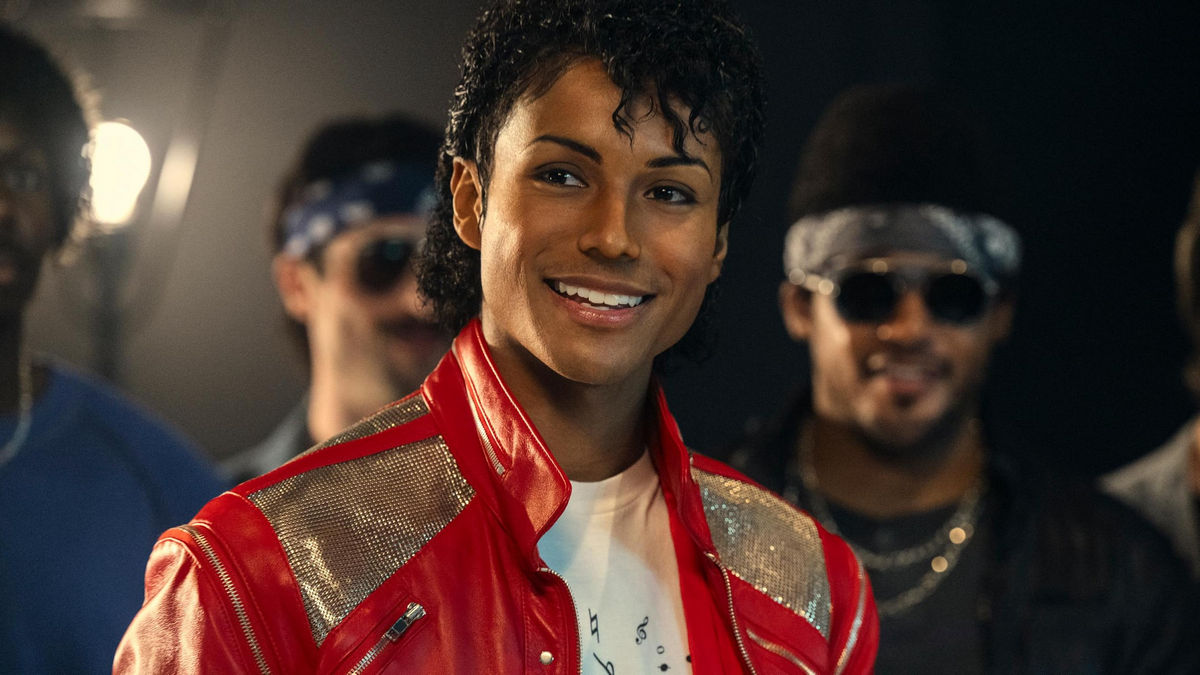
Directed by Antoine Fuqua and written by John Logan, Michael traces the early life and rise of the King of Pop, with Jaafar Jackson stepping into the role of his uncle. It’s a casting choice that immediately draws attention, not just because of the resemblance, but because of the expectations that come with it.
The film opens in 1966, when Joseph Jackson begins shaping what would eventually become the Jackson 5. From the outside, it looks like the origin of something extraordinary. But the film doesn’t completely ignore what’s happening beneath that surface.
There’s discipline. There’s pressure. And at times, there’s something harsher.
Michael, still a child, stands at the center of it all. As the lead vocalist of the group, his presence is impossible to overlook. The early success of the Jackson 5, signing with Motown, climbing the charts, performing across the country, unfolds quickly, but not without leaving an impression of how much was demanded from him at such a young age.
As the story moves forward, the shift toward a solo career begins to feel inevitable.
There’s a quiet tension in those moments. On one side, there’s Joseph, holding tightly to control. On the other, there’s Michael, slowly stepping into his own identity as an artist. When he eventually signs with Epic Records, it doesn’t feel like a dramatic rebellion. It feels more like a necessary step, one that had been building for years.
From there, the film leans more heavily into its musical core.
The creation of Thriller becomes one of the central highlights, not just as a career milestone, but as a creative process. The film takes its time here, showing how ideas come together, how inspiration takes shape, and how Michael approaches his work with a level of detail that goes beyond performance.
Moments like the development of “Beat It” and the influence behind “Thriller” itself give the film a rhythm that feels more immersive than explanatory.
There are also glimpses into his personal struggles, though they are handled with restraint.
His insecurities are acknowledged, particularly in the way he sees himself, leading to decisions like his rhinoplasty. The film also touches on his diagnosis with vitiligo, offering context without turning it into a defining narrative. These moments are present, but they rarely linger long enough to fully explore the emotional weight behind them.
His relationship with his father remains one of the film’s more consistent threads. It’s not overly dramatized, but the tension is always there, sometimes in direct conflict, sometimes in quieter, more uncomfortable interactions.
Eventually, Michael chooses distance. Moving out of the family home feels less like a turning point and more like something that had been coming for a long time.
As his career continues to rise, the film begins to highlight the external challenges he faced as well.
One of the more notable moments comes when Michael pushes for his music videos to be played on MTV. The resistance he encounters, and the role Walter Yetnikoff plays in confronting that barrier, adds another layer to the story, one that hints at the broader industry dynamics without fully diving into them.
It’s one of the few points where the film briefly steps outside of Michael’s personal world and acknowledges the environment around him.
Then there’s the Pepsi commercial incident.
It’s one of the film’s more intense sequences, not just because of what happens, but because of how quickly things shift. A moment meant to reinforce his global image turns into something far more serious, leaving him with lasting physical damage. What follows, his decision to donate the settlement money to the burn center, feels like one of the film’s more sincere emotional beats.
But even here, the film maintains its distance. It presents the moment, allows it to resonate, and then moves forward.
And that pattern continues into the final act.
The Jackson 5 reunion tour brings Michael back to where everything started, at least on the surface. But by this point, the dynamic has clearly changed. The final performance, where he announces that it will be the last time the group performs together, carries a quiet sense of closure.
Not dramatic. Not explosive. Just final.
His refusal to reconnect with his father adds another layer to that moment, one that the film doesn’t fully unpack, but doesn’t ignore either.
From there, the film moves forward to 1988, ending with a performance at Wembley Stadium during the Bad tour.
It’s a fitting image to close on, Michael at his peak, in front of a massive audience, fully in control of his stage. And yet, it also feels like a pause rather than a conclusion.
The final note, hinting that his story continues, makes that even more explicit.
And that brings up a larger question that lingers after the film ends.
Does Michael do justice to its subject?
In some ways, it does.
As a musical experience, the film works. The performances are carefully recreated, the energy of the songs is preserved, and there’s a clear appreciation for Michael Jackson’s artistry. You can see the effort, especially in how the film handles the creation of his music.
Jaafar Jackson’s performance also deserves some recognition. There’s commitment in the physicality, in the movement, in the attempt to capture something that is, in many ways, impossible to replicate exactly.
But at the same time, the film feels selective.
It chooses what to show, and just as importantly, what not to show.
The more controversial aspects of Michael Jackson’s life are largely absent. The complexities, the contradictions, the parts of his story that have been widely discussed for years, they remain outside the frame.
Because of that, the film often feels less like a full portrait and more like a carefully curated version of one.
For some viewers, that may not be an issue. The film is accessible, focused, and easier to engage with without the weight of those heavier topics.
For others, especially those expecting a deeper exploration, it may feel incomplete.
There’s also a sense that the film is aware of its own limitations. It doesn’t attempt to force a definitive conclusion. Instead, it leaves space, perhaps intentionally, for future installments to continue the story.
In the end, Michael (2026) feels less like a final statement and more like an opening chapter.
It revisits the rise of a global icon with care, attention, and a clear sense of admiration. But it stops short of fully stepping into the more difficult parts of that story.
And maybe that’s the trade-off it chooses to make.