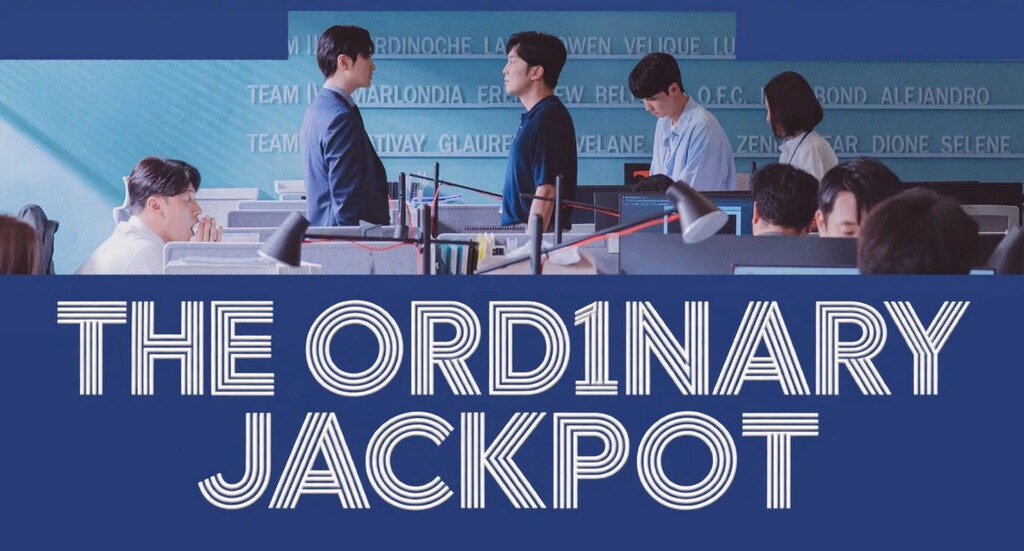
K-Drama · tvN & TVING · Spoiler warning: this article explains the entire Season 1 finale of The Ordinary Jackpot.
Eun-tae ends The Ordinary Jackpot exactly where the story began: standing in a convenience store, holding cash, with a card machine that does not work. Between those two scenes, he wins a corporate war, loses a friend and wins him back, gets promoted and makes one costly mistake with the CEO. This The Ordinary Jackpot ending explained guide answers the biggest questions from Episode 10, including Ji-hye’s firing, the cafe owner’s secret and that last smile. For everything that leads up to it, start with our The Ordinary Jackpot Season 1 full recap, review and character analysis.
Quick Answers
- Does Eun-tae win against CGM? Yes. Hongsung International partners with Mantua and reaches the Chinese market first, and the department stores that fled come back.
- Do Eun-tae and Jun-ho get promoted? Yes. Eun-tae becomes deputy general manager of sales planning and Jun-ho becomes manager.
- Does Ji-hye become a full-time employee? No. The CEO fires her after Eun-tae asks for it.
- Where does Ji-hye end up? At Mantua, thanks to a backup plan Eun-tae arranged with Sponza.
- Is there a Season 2? Not announced as of October 19, 2026.
How does The Ordinary Jackpot end?
The finale opens with a recorded meeting between Hongsung International and the executives of the Belmore department store. Executive Director Gu has told Eun-tae he may go wild, and he does. When Belmore suggests sourcing a few brands from Gwangdong, the company CGM has taken over, Eun-tae points out that Mantua will not be happy about CGM using Gwangdong as a backdoor into China, where Belmore already runs stores. If Mantua is upset, it could pull every European luxury brand from Belmore’s first floor. He then announces that the common luxury rate is being lowered to 14%.
Afterward, Paradis Mall comes to apologize, Seon-hyeok finds Eun-tae on the rooftop, and Park is offered a director position. A restructuring email promotes Eun-tae and Jun-ho. Then the CEO invites Eun-tae upstairs and offers him a gift. His request for Ji-hye backfires, and she is fired, though Eun-tae has a backup plan ready. The cafe owner reveals he is a lottery winner too, and the series closes on Eun-tae back at the convenience store, smiling at a cashier who has no change.
How does Eun-tae beat Belmore?
By turning Belmore’s own tactic against it. In Episode 9, Belmore’s executive director, Kim Soon-wook, was the first to strong-arm Hongsung, demanding a higher commission rate. Hongsung now holds the stronger hand because it has secured Mantua, and Eun-tae uses that leverage. The threat that Mantua could withdraw its European brands is not a bluff, it is the logical result of the partnership he built, and the new 14% rate is Hongsung’s way of saying it is their turn to set the terms. The recorded minutes in the next room matter too, since every word is on the record.
What happens with Paradis Mall?
Think of it as the smaller echo of the Belmore scene. In Episode 8, a Paradis Mall team leader clashed with Jun-ho after store staff made Gi-tae carry heavy boxes under the threat of contract termination. In the finale, Kim comes to apologize and asks to carry on with the original contracts, then gets down on his knees. Jun-ho does not forgive him easily. He agrees to think it over on one condition: that Paradis Mall considers redesigning some of its interiors. It is a satisfying reversal and shows how far Jun-ho has come as a negotiator.
How does Hongsung beat CGM?
The victory is built across Episodes 8 through 10. The key is the Shenzhen deadline: the Chinese city announced that only brands opening stores before the end of the year would qualify for tariff benefits. That is why the department stores suddenly rushed to leave their Hongsung contracts, accepting penalties, so CGM could set up stores in Korea fast and use them as a route into China.
Eun-tae’s answer has three parts. First, drag out the contracts and collect the penalties. Second, partner with Mantua, which has access to many European luxury brands, and plant a flag in China first. Third, keep the plan secret from the mole. Episode 9 shows how it works: Jun-ho caught Joo-hee recording a conversation and knew she was feeding information to Seon-hyeok, so the team let the wrong story travel while Sponza agreed to lie to Seon-hyeok. Then Deputy Director Jang calls a reporter, the Mantua partnership goes public, and CGM is caught flat-footed. By the finale, the department stores that fled are the ones calling back.
What happens between Eun-tae and Seon-hyeok?
They part as friends. On the roof, the place where they used to talk, Seon-hyeok tells Eun-tae that CGM gave him another chance and that he is now working at Gwangdong. He knows the Mantua deal was Eun-tae’s idea. Even though he lost, he says he enjoyed working after leaving Hongsung, but he adds that Eun-tae learned to enjoy the job while still inside the company.
Eun-tae answers with something he has not said to anyone: even after winning the lottery, he felt lonely when he went home, and he missed his colleagues. They agree to get a drink once some time has passed. It is the quiet heart of the episode, and it fits the series’ argument that the real stakes of a rivalry like this are personal, not corporate.
Do Eun-tae and Jun-ho get promoted?
Yes, both of them. The restructuring email announces that Eun-tae becomes deputy general manager of sales planning and Jun-ho is promoted to manager. Park also gets good news. Gu merges Sales Teams 1 and 2, opens a new Sales Director role and offers it to her, and she accepts with thanks. At the celebration dinner, Jun-ho jokes that the team’s performance improved from the day Eun-tae got mad at him, a callback to the Episode 2 blowup that started everything.
What did Eun-tae ask the CEO for?
An old man walks into Hongsung and goes straight to Gu. He is the CEO, and he asks to see Eun-tae, which makes Deputy Director Jang nervous because it is the first time the CEO has requested someone like this. In the CEO’s office, Eun-tae is congratulated on his promotion and offered a gift, anything within the CEO’s power. Eun-tae asks for Ji-hye to be converted from a contract worker to a full-time employee, the promise he made to her on the rooftop in Episode 4.
Why does the CEO fire Ji-hye?
Because the CEO treats the request as a failure of imagination. A flashback shows that he was disappointed Eun-tae spent his gift on one person instead of asking for a structural change, and he told Eun-tae that management-level employees need to think about the bigger picture. As a consequence, he decides to dismiss Ji-hye.
The show leaves little doubt that the punishment is out of proportion. Ji-hye did nothing wrong, and the CEO barely appears in the series before this moment, which makes his judgment hard to buy. The more interesting reading is thematic: the series has spent ten episodes showing Eun-tae using personal courage to fix problems, and the CEO’s lesson is that personal favors inside a system are not the same as changing the system. That does not make the firing fair, but it explains why the show lets Eun-tae lose here.
Where does Ji-hye work after being fired?
With Mantua. Eun-tae asks Ji-hye if she would be willing to work abroad, since Mantua will be sending far more goods to South Korea and someone will need to handle that full-time. Sponza is ready to hire her, and Ji-hye tears up. A flashback shows that Eun-tae had already told Jun-ho about this backup in case the promotion did not happen.
The soft landing is both comforting and a little convenient. It pays off the Ji-hye thread, but it also softens the sting of the firing almost immediately. Still, there is a nice logic to it: Ji-hye impressed Martina in Episode 9 by politely telling her that respect has to go both ways, and that quiet confidence is exactly what a Mantua partnership needs. Her reminder to Eun-tae that her value does not change no matter how her work turns out also shows she has absorbed his Episode 4 advice better than he has.
Who is the cafe owner and what does his secret mean?
The cafe owner turns out to be a lottery winner too, and he tells Eun-tae he recognized it in him. That recontextualizes his Episode 2 advice to not rush into anything and let the money sit as quiet security. It was not a stranger’s guess, it was experience.
In the finale, Eun-tae asks him the question the whole series has circled: he has not spent any of his money, yet his life has changed, so could he have lived this way without it? The owner answers that, looking back, the money changed his life as well. The answer is deliberately unspecific. It suggests the money mattered, not as a purchase, but as the thing that gave him the freedom to behave differently.
Why hasn’t Eun-tae told anyone about his win?
The series never says, and it is one of its odder omissions. He keeps the secret through all ten episodes, even from Hae-joo and from the rooftop conversation with Seon-hyeok, where he admits he felt lonely after winning. One reading is that the secrecy is the point: if no one knows, his boldness has to come from him rather than from a reputation for wealth. Another is that the secret is the loneliness. Either way, the cafe owner is the only person who sees it.
What does the final convenience store scene mean?
The epilogue mirrors the first episode. Eun-tae is buying a drink, the card machine is not working, he offers cash and the shop has no change. The cashier asks how he would like to handle it. Eun-tae simply smiles. We do not see what he chooses.
There are two natural readings. The first is that the smile shows he is at ease with a small inconvenience, someone who no longer swallows frustration but also no longer needs to fight over it. The second is that the show is quietly asking whether he will take another lottery ticket in place of change, and whether luck would change anything this time. The open ending works because the answer does not matter to the man he has become, and that is the series’ final point: the jackpot was never really the whole story.
Does the lottery money change anything?
This is the question the series raises and, honestly, only half answers. In Episode 7, Eun-tae decides that nothing has changed. In Episode 2, the real estate agent reminds him that his salary is worth more over a lifetime than his winnings. In the finale, the cafe owner says the money changed his life after all. The closest the show comes to a thesis is that the money gave Eun-tae permission to get angry, to ask for more and to stop swallowing disrespect. That is a real change, but it is a change in behavior rather than in lifestyle, and the show spends more time on workplace maneuvers than on exploring what money does to a person. It is the one place where the ending feels thin.
Is there a Season 2?
As of October 19, 2026, The Ordinary Jackpot has not been renewed for a second season. The ten-episode run finished on TVING on October 8 and on tvN on October 13, and reports tracking the series list it as not yet renewed, noting that Korean dramas are rarely renewed and that workplace dramas like this tend to be built around one complete character journey. The ratings were strong at the end: the finale hit 6.2 percent, the highest of the run, but a tidy arc and a strong finish do not guarantee a continuation. If a second season did arrive, the open convenience store ending and the unresolved lottery secret would give it something to work with.
FAQ
Does Ji-hye get a full-time job in The Ordinary Jackpot? Not at Hongsung. After Eun-tae asks the CEO to convert her contract, the CEO fires her instead. Eun-tae then arranges a job for her with Mantua through Sponza.
Do Eun-tae and Jun-ho get promoted? Yes. Eun-tae becomes deputy general manager of sales planning, and Jun-ho is promoted to manager.
Is the cafe owner a lottery winner too? Yes. He tells Eun-tae he recognized it in him, which explains his Episode 2 advice to let the money sit.
What does the ending of The Ordinary Jackpot mean? The epilogue repeats the first episode’s convenience store scene, with the card machine down and no change for cash. Eun-tae smiles, and the show leaves his choice open.
How does Eun-tae beat CGM? He drags out department store contracts, partners with Mantua to reach China before CGM, and leaks the news to the press after exposing the mole, Joo-hee.
Does Seon-hyeok forgive Eun-tae? They reconcile on the rooftop. Seon-hyeok now works at Gwangdong, and the two agree to share a drink after some time has passed.
Is there a Season 2 of The Ordinary Jackpot? No second season has been announced as of October 19, 2026.
Need to catch up? Read our episode-by-episode recap, the Episode 10 recap or browse the complete cast and episode guide.