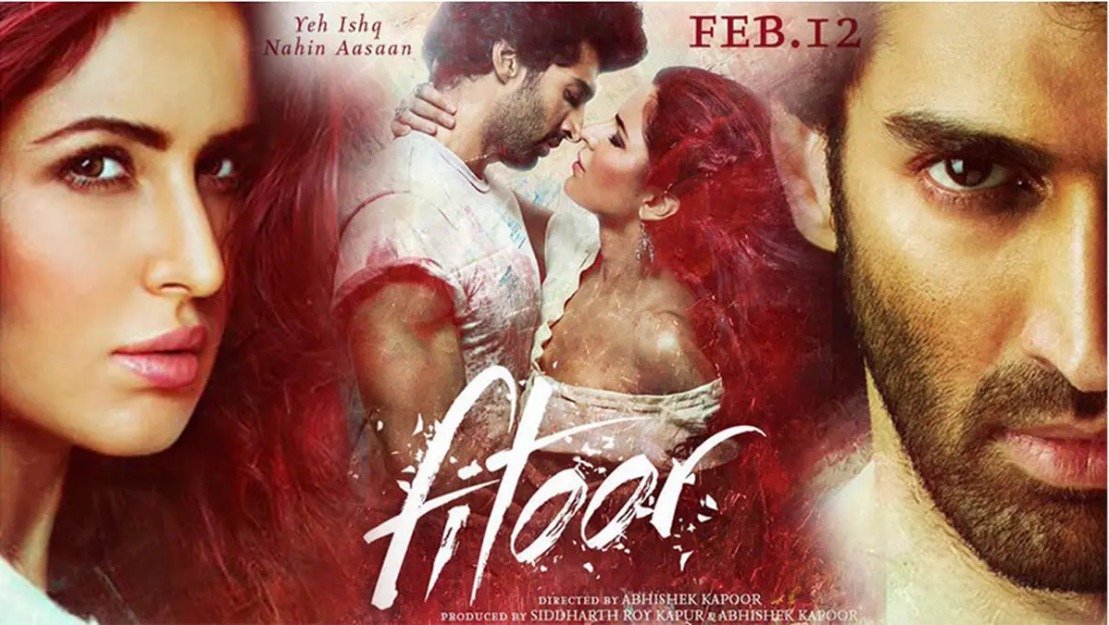
Fitoor (2016) is a visually striking Indian romantic drama directed by Abhishek Kapoor. Set against the breathtaking backdrop of Kashmir and later unfolding in Delhi and London, the film tells the story of obsessive love, class divides, emotional manipulation, and the scars left by unfinished past relationships. Inspired by Charles Dickens’ Great Expectations, the film reshapes the classic tale into a modern Indian tragedy about passion, pride, and destiny.
Starring Aditya Roy Kapur, Katrina Kaif, and Tabu, Fitoor is not just a love story. It is a layered emotional journey where love is both a dream and a burden, and where the past refuses to let the present breathe.
A Love Born in Snow and Silence
The story begins in Kashmir, where a young boy named Noor grows up in poverty. At just 13 years old, he works for a wealthy household and there he meets Firdaus, the beautiful daughter of Begum Hazrat Jahaan. Noor is immediately captivated by Firdaus. His admiration is innocent but intense, the kind of childhood infatuation that feels eternal.
However, Firdaus’ mother, Begum Hazrat Jahaan, disapproves of Noor. She sees him as socially inferior and unsuitable for her daughter. Beneath her cold demeanor lies a deeply wounded woman shaped by betrayal in her youth.
Despite the class difference, Noor and Firdaus grow close. Their bond strengthens quietly until Hazrat decides to separate them by sending Firdaus abroad for her education. Noor is left behind in Kashmir, carrying heartbreak that silently transforms into ambition.
Years later, Noor grows into a talented young artist. His obsession with Firdaus fuels his creativity. When he receives a prestigious art scholarship, he moves to Delhi, determined to make something of himself, perhaps worthy enough to stand beside her.
Fate brings them together again. Firdaus, now an elegant and sophisticated woman, is engaged to Bilal, a Pakistani diplomat. Yet, when Noor and Firdaus reunite, the old feelings resurface instantly. Their love rekindles, fragile yet powerful.
But Hazrat is still watching, and still controlling.
The Emotional Chessboard: Power, Pride, and Manipulation
Begum Hazrat Jahaan is the emotional axis of Fitoor. Her past explains her cruelty. As a young woman, she once fell in love with a man named Mufti. When she became pregnant, they planned to elope. But Mufti betrayed her, stealing her jewelry and abandoning her.
The humiliation shattered Hazrat’s faith in love. She lost her unborn child under immense stress caused by her father’s anger. Firdaus, it is later revealed, is adopted.
This trauma turns Hazrat into a woman determined never to let love weaken her again. She projects her pain onto Firdaus’ life, forcing her into an engagement with Bilal to ensure security and status. Noor, in her eyes, represents risk, the same kind of romantic madness that once destroyed her.
Meanwhile, Noor’s success as an artist begins to flourish. His exhibitions gain attention. Yet, unknown to him, his artistic rise is not entirely organic.
During a trip to London for an art show, Noor discovers a shocking truth: his scholarship and much of his success were secretly financed by Moazam (cameo by Ajay Devgn), a man he once saved as a child, now revealed to be a wanted terrorist. Moazam has been purchasing Noor’s artwork to artificially inflate his career.
This revelation devastates Noor. His pride collapses. Everything he believed he earned feels manipulated. Even his success seems like another game orchestrated by others, especially Hazrat.
When Noor confronts Hazrat, her emotional state spirals. Years of suppressed trauma erupt in anger. Overwhelmed by guilt and memories of her lost love, Hazrat eventually takes her own life.
Noor, Firdaus, and Hazrat: A Study of Obsession and Emotional Inheritance
Noor is not just a romantic hero. He is obsessive, vulnerable, and deeply emotional. His love for Firdaus is pure but also consuming. His art is fueled by longing. Yet, his biggest weakness is tying his identity entirely to his love.
Firdaus, on the other hand, grows up under her mother’s shadow. She is beautiful, poised, yet emotionally restrained. For much of the film, she seems passive, torn between duty and desire. Only toward the end does she truly confront her own feelings and make an independent choice.
Hazrat is arguably the most complex character in the film. She is not a simple antagonist. She is a woman broken by betrayal, who chooses control over vulnerability. Her manipulation of Noor and Firdaus is cruel, but it comes from fear, fear of reliving her own past.
In many ways, Hazrat represents generational trauma. Her inability to heal transfers emotional damage to the next generation.
Ending Explained: Breaking the Cycle of Broken Love
After Hazrat’s death, a significant moment unfolds during her funeral. Firdaus opens a locket and finds a photograph of Mufti, her mother’s lost love. In that moment, Firdaus realizes something powerful: despite everything, Hazrat never stopped loving Mufti.
This changes her perspective. She understands that suppressing love leads only to lifelong regret. Hazrat tried to erase her past, but love remained embedded in her heart.
Firdaus then makes her final decision. She leaves Bilal and chooses Noor.
The ending suggests a symbolic breaking of the cycle. Where Hazrat chose pride over love, Firdaus chooses vulnerability. Where Hazrat allowed betrayal to define her life, Firdaus refuses to let fear control hers.
Noor burning the artworks connected to Firdaus earlier in the film symbolizes letting go of obsession. By the time Firdaus returns to him, their love feels less like fantasy and more like choice.
The film’s message becomes clear: love cannot survive control, but it can survive pain, if one is brave enough.
Verdict: Beautiful but Emotionally Uneven
Fitoor is undeniably beautiful to look at. The cinematography by Anay Goswamy captures Kashmir’s snowy landscapes and Delhi’s artistic atmosphere with elegance. The music by Amit Trivedi enhances the emotional tone, especially the romantic tracks that linger long after the film ends.
Tabu delivers the most compelling performance as Begum Hazrat Jahaan. She carries the emotional weight of the story with quiet intensity. Aditya Roy Kapur brings sincerity to Noor, though his character occasionally feels overly passive. Katrina Kaif portrays Firdaus with grace, but the emotional depth of her character sometimes feels underwritten.
Narratively, the film struggles with pacing. Some plot twists, particularly the Moazam revelation, feel dramatic but slightly disconnected from the central romance. The emotional payoff is there, but it requires patience.
Still, Fitoor succeeds as a tragic love story about obsession, pride, and emotional inheritance. It may not be flawless, but its themes resonate.
Rating: 3.5 out of 5
Fitoor is a film that values mood over momentum. It is poetic, dramatic, and occasionally frustrating, but at its core, it reminds viewers that love, when denied, becomes regret. And sometimes, the bravest thing one can do is choose love before it is too late.