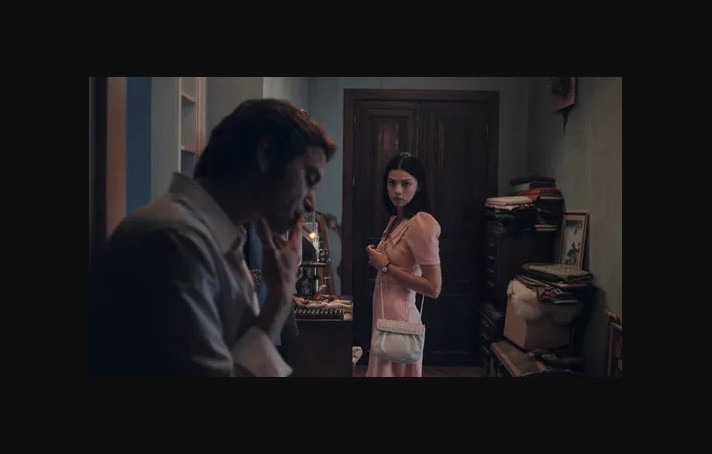
Set against the restless backdrop of 1970s Istanbul, Museum of Innocence (2026) arrives on Netflix as an ambitious adaptation of Orhan Pamuk’s celebrated novel. Framed as a sweeping tale of longing, it asks a question that has echoed through literature for centuries: what is love, really? Is it devotion, passion, sacrifice, or something far less flattering?
Across nine episodes, the series follows Kemal, a wealthy thirty-year-old man, whose life is upended when he reconnects with his distant cousin, Fusun, an eighteen-year-old shop assistant. What unfolds is presented as an epic romance. Yet beneath the soft lighting and nostalgic production design lies a more troubling portrait, one of obsession, entitlement, and the uneasy line between desire and control.
This review focuses solely on the Netflix series rather than the original novel. As television, Museum of Innocence is undeniably polished. But emotionally and thematically, it leaves behind a complicated aftertaste.
A Love Story Told from One Side
From the very beginning, the story is filtered through Kemal’s perspective. He is about to become engaged to Sibel, a woman from his own social circle, when he meets Fusun at a local boutique while shopping for a gift. Their connection is immediate, at least for him. He is captivated, barely able to hide his fixation.
The series quickly clarifies that Kemal and Fusun are not blood relatives, perhaps to ease potential discomfort. It also leans heavily on its 1970s setting, subtly suggesting that viewers should not judge the relationship through a modern moral framework. Still, the significant age gap and imbalance of power are impossible to ignore.
Kemal pursues Fusun persistently. She hesitates, aware that he is already committed to someone else. Yet she is drawn to him, and an affair begins. Fusun visits Kemal at his spare apartment, and their relationship intensifies in secrecy. For Kemal, her lack of expectations becomes part of the allure. He interprets her emotional surrender as purity, even innocence, language that reveals more about his own fantasies than about who Fusun truly is.
Despite declaring his love for Fusun, Kemal never breaks off his engagement to Sibel. Instead, he proceeds with the engagement ceremony and even invites Fusun and her family to the lavish celebration. The emotional cruelty of this decision is staggering. While Kemal beams with excitement at Fusun’s presence, he seems oblivious, or indifferent, to the humiliation she endures.
His selfishness becomes increasingly evident. He expects Fusun to accept his choices, to remain available, and to feel honored by his attention. When he sees her dancing with another man, jealousy consumes him. Ironically, this possessiveness emerges at his own engagement party, where he risks his public image by dancing intimately with Fusun in front of family and friends.
For Kemal, love is not mutual understanding. It is possession.
Obsession as Devotion
The series then shifts into the long shadow of obsession. Kemal spends nearly a decade circling Fusun’s life, convinced that one day he will win her back. During this time, he develops a disturbing habit: he begins stealing small objects that Fusun has touched, trinkets, everyday items, anything that allows him to feel close to her.
The narrative frames this behavior as tragic devotion rather than alarming fixation. Fusun and her family are clearly uncomfortable, yet they rarely confront him directly. Kemal’s social status and wealth create an invisible barrier; his influence silences protest.
This is where the show’s central weakness becomes most apparent. Because the story is told almost entirely from Kemal’s point of view, his actions are wrapped in justification. Through monologues and reflective narration, he rationalizes his lies, his manipulation, and his possessiveness. Instead of fully exposing his behavior as destructive, the series often softens it with romantic imagery and melancholy music.
There are glimpses of the damage he causes. Sibel’s heartbreak is evident when she realizes Kemal’s emotional betrayal. Yet Sibel herself remains underdeveloped. We see her pain, but we rarely see her interior world. She becomes collateral damage in Kemal’s grand narrative of longing.
Fusun, too, is initially portrayed less as a person and more as an idea, a symbol of purity and unattainable desire. For much of the series, she exists inside Kemal’s imagination rather than as a fully realized character.
The Women Beyond Kemal’s Gaze
It is only in the final two episodes that Museum of Innocence begins to rebalance its perspective. Fusun gradually emerges as more than an object of fascination. We begin to understand her aspirations, her frustrations, and the constraints imposed by both class and gender.
The series touches on a compelling theme: the intersection of women’s sexual freedom and social class in 1970s Turkey. Fusun’s reputation carries different consequences than Kemal’s. While he can indulge in scandal without lasting repercussions, her choices are scrutinized and judged. This contrast is one of the most powerful undercurrents in the show.
Kemal’s mother becomes a surprising voice of clarity. Her observations about her son’s concept of love, and the nation’s anxiety over women’s independence, cut through the romantic haze. She articulates what the series sometimes struggles to say outright: that what Kemal calls love may in fact be control disguised as devotion.
The political unrest of the era hovers in the background. Graffiti, street protests, and references to the 1980 military coup remind viewers that the country is in turmoil. Yet these elements remain peripheral. One could argue that this detachment is intentional, highlighting how the elite class can afford to remain absorbed in personal drama while the nation fractures. Still, the political dimension never feels fully integrated into the emotional core of the story.
Love or Narcissism? A Theory on the Ending
The culmination of Kemal’s obsession is the creation of a museum dedicated to Fusun, a physical archive of the objects he collected over the years. The gesture is framed as monumental, even heroic. A man so devoted that he immortalizes his love in glass cases and curated memories.
But is this devotion, or the final act of narcissism?
One interpretation is that the museum is less about honoring Fusun and more about preserving Kemal’s version of events. It is his narrative, his longing, his tragedy on display. The artifacts become evidence not of shared love, but of his inability to let go.
If the series intended satire, a critique of men who mistake obsession for romance, the message becomes blurred by its aesthetic choices. The soft cinematography, the swelling score, and the poetic voiceovers risk romanticizing what should perhaps feel unsettling.
The dissonance between Kemal’s internal mythology and external reality is almost fully realized, but not quite. The show edges toward exposing him as an unreliable narrator, yet it stops short of fully dismantling his self-image.
Visual Splendor and Missed Opportunities
There is no denying the craftsmanship. The production design is lush, meticulously detailed, and immersive. Istanbul of the 1970s feels alive through carefully curated interiors, fashion, and lighting. Several scenes are visually striking, almost painterly.
Kemal himself is a fascinating protagonist, not because he is admirable, but because he is flawed, contradictory, and often dishonest. Modern storytelling no longer requires likeable heroes, and *Museum of Innocence* could have embraced that fully. Instead, it hesitates, softening the sharp edges of its central character.
The result is a series that brims with potential. It had all the ingredients for a nuanced exploration of toxic love, class privilege, and memory. Yet by cushioning Kemal’s actions with romantic framing, it undermines its own critique.
Final Thoughts & Rating
Museum of Innocence (2026) is visually elegant and thematically ambitious. It dares to center an unreliable, morally questionable protagonist and situates his obsession within a complex social and political landscape.
However, the execution falters in its perspective. By filtering nearly everything through Kemal’s gaze, the series risks validating the very behavior it could have interrogated more sharply. The final episodes redeem some of this imbalance by giving Fusun greater depth, but the shift arrives late.
At its best, the show sparks meaningful questions about love, power, and the stories men tell themselves to justify desire. At its weakest, it romanticizes obsession under the guise of epic devotion.
Rating: 3 out of 5 stars
A beautifully crafted drama that invites conversation, but not without frustration.