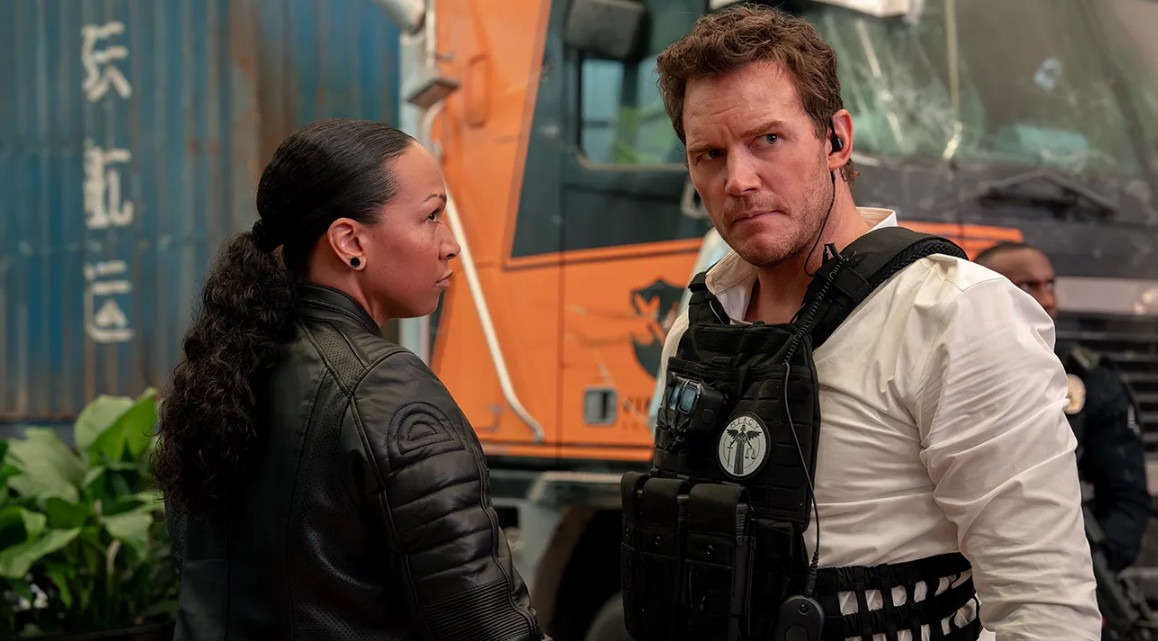
Chris Pratt’s Mercy is the kind of movie that feels questionable from the moment you hear the premise. An AI judge. Ninety minutes to prove your innocence. Execution immediately after the verdict. It sounds like high-concept science fiction designed to spark debate about technology, justice, and human error.
Instead, Mercy (2026) delivers something far more baffling, and far less thoughtful, than its premise promises.
Directed by Timur Bekmambetov and released on January 23, 2026, the film imagines a near-future Los Angeles where a system called Mercy Court has replaced traditional judges in violent criminal cases. The AI, represented physically by Judge Maddox (Rebecca Ferguson), analyzes surveillance footage, digital data, and behavioral history. The accused is given 90 minutes to establish reasonable doubt. If the probability of guilt exceeds 92 percent, execution follows almost immediately.
It’s a premise loaded with moral tension. But what unfolds is less a nuanced exploration of AI justice and more a chaotic thriller that struggles with its own logic.
Let’s break down what Mercy tries to do, and why it doesn’t work.
A Trial That Begins Before the Crime Scene Is Cold
Chris Pratt plays Chris Raven, a police officer who wakes up strapped to a chair in an empty room. He has no memory of the previous night. He soon learns that his wife, Nicole (Annabelle Wallis), has been murdered, and he is the prime suspect.
Judge Maddox appears before him as the AI authority overseeing his case. Raven has 90 minutes to review evidence and prove that there is less than a 92 percent probability he committed the crime.
The first major issue becomes obvious almost immediately: this trial is happening on the same day as the murder. Just hours after Nicole’s death.
The investigation is barely underway. Evidence has been collected quickly, Ring camera footage, phone records, bar surveillance, but the scene has not been thoroughly processed. Yet Mercy Court moves forward with life-or-death consequences.
The evidence against Raven looks damning. He has a drinking problem. He has a documented temper. Earlier that night, he violently resisted arrest at a bar. A home security camera captures him entering the house minutes before Nicole is stabbed.
From a probability standpoint, Mercy’s case seems airtight.
But from a justice standpoint, it feels reckless.
Raven does not have a lawyer. He does not have proper counsel. He is severely hungover. His only advantage is that he is a police officer with friends who can help from the outside.
For a system meant to represent technological precision, the urgency feels less efficient and more absurd.
AI Logic, With Human Feelings?
One of the film’s most confusing elements is Judge Maddox herself.
The Mercy system claims to rely strictly on facts and statistical analysis. No emotion. No bias. Just data.
Yet as Raven begins to argue his innocence, Maddox starts to hesitate. Her facial expressions soften. She questions her conclusions. She even appears to develop a sense of empathy.
The AI judge is, somehow, having emotional growth during a murder trial.
This raises a fundamental contradiction. If Mercy is designed to eliminate human bias, why is its public-facing AI allowed to simulate, or even develop, human intuition? If it can “feel,” then it is no longer purely objective. If it cannot feel, then the emotional cues serve no narrative purpose.
The film seems to want both: cold technological authority and compassionate reconsideration. The result is neither convincing nor coherent.
The Real Villain and the Conspiracy Beneath the System
As Raven digs deeper, the story widens.
Rob Nelson (Chris Sullivan), a coworker of Nicole’s and Raven’s AA sponsor, becomes central to the mystery. Rob’s brother was the first person ever tried and executed by the Mercy system.
That case was meant to establish public confidence in AI justice.
But here comes the film’s major twist: the system was manipulated from the very beginning.
Raven eventually uncovers that his former police partner, Jaq Diallo (Kali Reis), deleted key evidence in that first high-profile case. The removal ensured the conviction would appear decisive and successful. The goal was to present Mercy as flawless during its launch.
Because of that deleted evidence, Rob’s brother, potentially innocent, was executed.
Rob’s grief and anger ultimately drive him to murder Nicole and frame Raven. He also constructs a bomb using industrial chemicals, intending to destroy the Mercy headquarters with Raven inside.
This revelation reframes the entire narrative.
The failure of Mercy is not presented as technological malfunction. It is human corruption that compromises the system.
Jaq manipulated the data. Mercy delivered the sentence based on incomplete information.
The system did exactly what it was programmed to do.
That may be the film’s central thesis: AI is not inherently evil, humans are.
But even that message feels underdeveloped.
The Bomb, the Showdown, and a Last-Minute Trial
The final act descends into chaos.
Rob drives an explosive-filled 18-wheeler toward downtown Los Angeles. Despite the futuristic technology shown throughout the film, including flying motorcycle-style aircraft, authorities struggle to stop what amounts to a speeding truck.
Rob takes Raven’s daughter hostage and confronts Mercy directly. Judge Maddox releases Raven so he can stop the threat.
What follows is a fight sequence between Raven and Rob that lacks the intensity the situation demands. It feels oddly staged, undercutting the stakes of thousands of lives potentially at risk.
Then comes another strange decision: Rob, surrounded by explosives and fresh off attempted mass murder, is allowed to present evidence regarding his brother’s case.
In the middle of a crisis.
Within minutes, new sleuthing reveals that Jaq buried evidence two years earlier. The truth emerges. Raven is cleared. Rob’s motive is confirmed.
And just like that, Mercy’s credibility collapses.
Authorities decide to shut down the system entirely.
Mercy (2026) Ending Explained: Who Manipulated the AI Justice System?
The ending of Mercy centers on one key revelation: Jaq Diallo manipulated the system from the start.
She deleted exculpatory evidence in the first major case assigned to Mercy Court. That wrongful execution set off a chain reaction. Rob Nelson sought revenge. Nicole became collateral damage. Raven was framed.
The AI itself did not malfunction.
It processed the data it was given.
The film ultimately suggests that automated justice is only as reliable as the humans who feed it information. When evidence is altered or removed, even the most advanced system becomes compromised.
Judge Maddox’s hesitation in the final act symbolizes this realization. The system’s shutdown reflects a loss of public trust.
Yet the broader implications, oversight, accountability, legal safeguards, are barely explored.
The story closes the immediate mystery but avoids deeper engagement with how such a system could ever be responsibly implemented.
A Sci-Fi Thriller That Feels Strangely Small
Beyond the narrative issues, the film suffers visually and structurally.
A significant portion of Mercy consists of close-ups: Chris Pratt staring intensely. Rebecca Ferguson maintaining stoic composure. Dialogue exchanges inside a confined space.
For a high-concept science fiction thriller about AI justice and systemic corruption, it feels visually static.
The pacing also struggles. The ticking clock should generate tension, but technological glitches, buffering issues, power disruptions, system delays, repeatedly interrupt momentum.
Instead of amplifying suspense, these interruptions make the process feel clunky.
Even the moral stakes feel uneven. The film gestures toward commentary on predictive policing, wrongful convictions, and technological overreach, yet it never fully commits to exploring those themes with clarity.
Final Review: Ambitious Concept, Unsteady Execution
Mercy wants to be a provocative sci-fi thriller about the dangers, or limitations, of AI-driven justice. It sets up a world where efficiency replaces deliberation and probability replaces reasonable doubt.
But the film’s logic collapses under scrutiny.
The timeline feels implausible. The courtroom structure lacks procedural credibility. The emotional arc of the AI judge contradicts the system’s premise. And the final revelation, while dramatic, does not land with the weight it should.
There is an interesting idea buried inside Mercy: that technology cannot eliminate injustice if humans remain flawed. That systems built for speed may sacrifice fairness. That trust in automation can be fragile.
Unfortunately, those ideas are overshadowed by inconsistent storytelling and uneven execution.
Chris Pratt delivers a committed performance, and Rebecca Ferguson brings quiet presence to Judge Maddox. But strong performances cannot fully compensate for a script that struggles to balance spectacle with substance.
In the end, Mercy (2026) is not a thoughtful indictment of AI justice, nor is it a tightly wound thriller. It sits awkwardly between commentary and action, never fully succeeding at either.
The concept deserved sharper writing and deeper exploration.
Instead, what could have been a tense and timely sci-fi drama becomes a confusing, occasionally frustrating experience that leaves more questions than answers, not about artificial intelligence, but about the storytelling itself.
Where to watch: