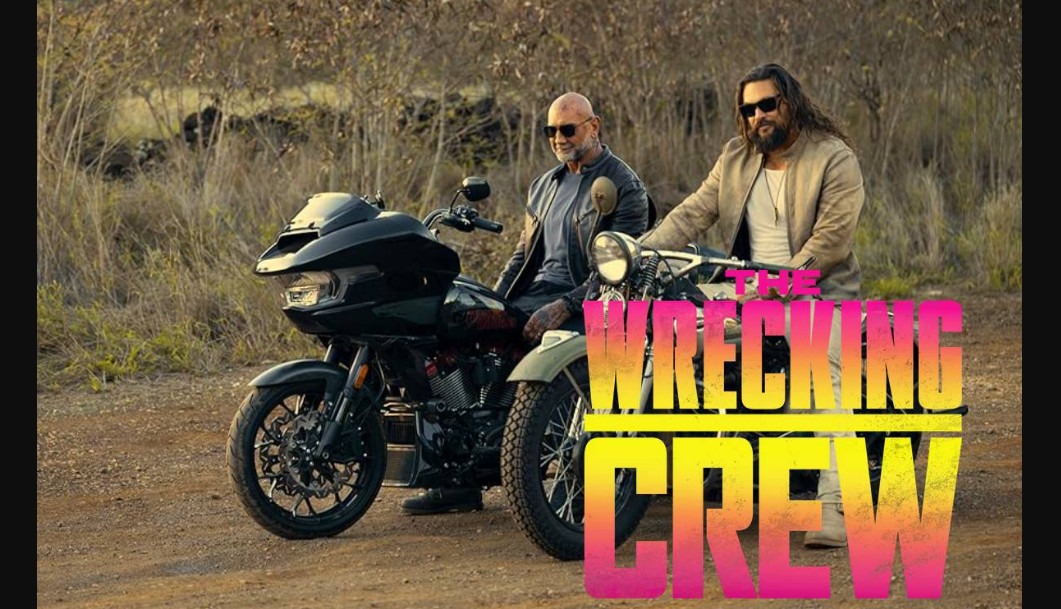
Amazon Prime’s The Wrecking Crew (2026) pairs Jason Momoa and Dave Bautista in an action-comedy that blends explosive set pieces with a surprisingly emotional story about family. On the surface, it’s about two estranged brothers investigating their father’s suspicious death. But underneath all the gunfire and punchlines, the film is really about guilt, regret, and the difficult work of reconciliation.
I went into this movie expecting chaos and charisma. What I didn’t expect was how much the brothers’ fractured relationship would carry the story. By the end, the action felt secondary to something far more personal.
Let’s break down what happened, and what it all meant.
Two Brothers, One Funeral, and a Lot of Unfinished Business
James (Bautista) and Jonny (Momoa) could not be more different.
James is disciplined, grounded, and stable, a Navy SEAL with a wife, Leila, and two children. Jonny, on the other hand, is messy, impulsive, and suspended from the police force. His romantic life is falling apart, and he carries unresolved anger from the past.
When their father, Walter, dies in what is initially described as a hit-and-run, James appears emotionally detached. It’s clear he wasn’t close to his father. But Jonny’s reaction is different. Suspicion creeps in almost immediately, especially after Yakuza members show up at his apartment demanding a mysterious package Walter supposedly sent him.
When Jonny kills the intruders in self-defense, the tone shifts. This is no ordinary accident. Their father was involved in something dangerous.
The funeral becomes less about grief and more about unfinished business.
Why Did James and Jonny Grow Apart?
The real tension in The Wrecking Crew isn’t just about a murder. It’s about what happened years ago between these two brothers.
Jonny’s mother was murdered when he was young. He made it his life’s mission to find her killer but failed. In his mind, James abandoned him when he needed help the most.
When Jonny is arrested during the investigation into Walter’s death, James bails him out. What follows is a long-overdue physical and emotional confrontation. Jonny accuses James of sending him to prison years ago instead of standing by him. James finally explains: he did it to protect him.
The K-Syndicate, a powerful criminal organization, would have killed Jonny if he had continued digging into his mother’s murder. Prison was safer.
It’s a painful revelation. Jonny felt betrayed; James believed he was saving him.
This confrontation is one of the film’s strongest moments. Beneath the punches and shouting, you can feel years of resentment unraveling. For me, this scene grounded the movie. It reminded me that sometimes love doesn’t look heroic, sometimes it looks like a terrible decision made out of fear.
By the end of that fight, they choose to move forward. Not perfectly. Not magically healed. But willing.
And that shift changes everything.
Why Was Walter Murdered?
Walter wasn’t just an old man who got unlucky. He was a private investigator involved in blackmail, digital surveillance, and corporate espionage.
Jonny discovers that Walter’s assistant, Pika, had been embedded at a high-end catering company. Meanwhile, they uncover blueprints with a government seal connected to a powerful developer named Marcus Robichaux.
Marcus comes from generational wealth and controls massive development projects across the globe. The blueprint in question? A casino, illegal in Hawaii.
That detail is key.
Marcus wanted to build a casino resort on protected land. To make that happen, he needed political backing. And that’s where Governor Peter Mahoe enters the picture.
Walter had been hired by Marcus’s wife, Monica, who suspected her husband of shady dealings. During his investigation, Walter uncovered evidence of illegal financial transactions tied to the casino project. He found proof that Marcus had been paying Governor Mahoe millions to legalize gambling.
When Walter got too close to exposing everything, he was eliminated.
Monica soon “falls” from a building, another death clearly orchestrated to silence her.
Walter wasn’t killed in a random hit-and-run. He was run down intentionally because he knew too much.
The Flash Drive and the $12 Million Secret
The mysterious package the Yakuza wanted? It contains a flash drive, a key to a digitally encrypted cold wallet.
James finds what turns out to be the seed phrase among Walter’s belongings. Together, the brothers access the account and discover $12 million in wire transfers routed through offshore accounts into a Cayman Islands account labeled “Mahoe P.A.”
The governor had been bought.
For three years, Marcus paid $12 million to ensure the casino project would move forward.
At this point, the conspiracy becomes clear. Walter uncovered corruption at the highest level. That sealed his fate.
When armed men arrive by helicopter and car to retrieve the drive, the film leans fully into action-comedy territory. The escape sequence is loud, ridiculous, and undeniably fun.
Logic may wobble at times, especially regarding how easily they access millions without immediate government intervention, but the movie isn’t aiming for realism. It’s aiming for momentum.
And it works.
Do the Brothers Kill Marcus?
Yes, and in classic over-the-top fashion.
After Marcus kidnaps Haunani (their cousin) and James’s wife Leila, the stakes become deeply personal. For Jonny, watching James’s son blame himself for not protecting his mother mirrors his own childhood trauma.
That parallel hit hard for me. It’s the moment Jonny stops chasing revenge and starts fighting for family.
The brothers storm Marcus’s property, taking down his guards and clashing with Yakuza forces in a sequence that feels like controlled chaos. Eventually, Jonny confronts Marcus on a boat.
Marcus admits to killing Walter. He underestimates Jonny, believing he doesn’t have what it takes to finish the job.
But Jonny reveals he stole a World War I grenade Marcus kept displayed in his office.
He pulls the pin.
Marcus dies in the explosion. Jonny falls into the ocean but is rescued by James, who keeps repeating, “I got you.”
That line says more than any apology earlier in the film.
It’s not just about saving Jonny physically. It’s about rewriting the past.
Will Jonny Avenge His Mother?
The governor is arrested. The financial trail is undeniable.
But there’s one final loose thread: Jonny’s mother’s killer.
Mr. K from the K-Syndicate hands Jonny a piece of paper with the name of the man responsible. He insists the syndicate wasn’t involved and offers the name as a gesture of respect, especially after the brothers eliminated the Yakuza threat.
For years, Jonny’s identity revolved around this unanswered question.
And then he burns the paper.
This is the film’s most important moment.
Revenge would mean reopening old wounds. It would mean risking Valentina, James, and the children. It would mean choosing the past over the present.
Jonny chooses differently.
He lets it go.
That decision feels more powerful than the explosion earlier. It signals growth. It signals peace.
He realizes that chasing revenge kept him tied to his trauma. Letting go allows him to finally move forward.
Final Thoughts
The Wrecking Crew may present itself as an action-comedy, but at its core, it’s a story about brothers learning how to stand beside each other again.
Yes, there are exaggerated action sequences. Yes, some plot logic stretches thin. But the emotional throughline, regret, protection, reconciliation, holds the film together.
What stayed with me wasn’t the grenade or the gunfights. It was that simple line: “I got you.”
Sometimes, that’s all healing really is.
In the end, Walter was murdered because he exposed corruption. Marcus died because he underestimated family. And Jonny survived because he finally chose love over revenge.
For a movie full of chaos, that’s a surprisingly grounded conclusion.