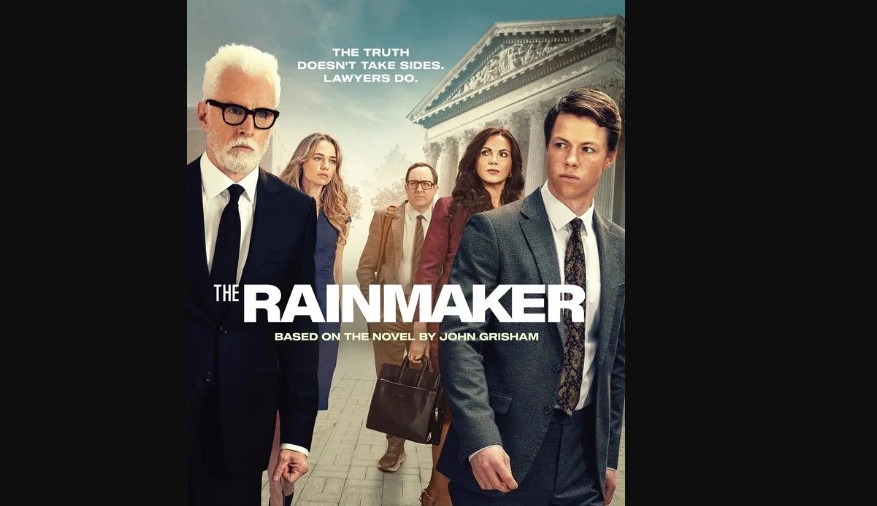
In the world of legal thrillers, few names carry as much weight as John Grisham. For decades, his stories have defined the genre-morally complex, emotionally grounded, and driven by the eternal struggle between ordinary people and powerful institutions. While the 1997 film adaptation of The Rainmaker is widely regarded as a classic courtroom drama, the The Rainmaker (2025) series arrives with a bold ambition: not merely to retell the story, but to reinterpret it for a generation that understands corporate power in far more intricate-and insidious-ways.
This new adaptation understands something crucial. In 2025, injustice rarely looks theatrical. It is buried under contracts, algorithms, digital fine print, and institutional delay. Corporate greed no longer hides behind smoke-filled rooms; it operates through data protection policies and legal loopholes that feel nearly impenetrable. By embracing this modern reality, the series transforms Grisham’s David vs. Goliath narrative into something urgently contemporary.
This long-form review will explore how the series modernizes the struggles of Rudy Baylor, the evolution of its supporting characters, the intensity of its courtroom drama, and whether this serialized version ultimately surpasses its cinematic predecessor. For fans of intelligent legal storytelling, The Rainmaker may very well be one of the most essential dramas of the year.
The Premise: David vs. Goliath in 2025
The core premise remains faithful to Grisham’s original vision: Rudy Baylor, a fresh law school graduate with limited prospects, stumbles into a case against a powerful insurance company that has denied a life-saving claim. It is the kind of case most young attorneys would avoid-complex, underfunded, and dangerously ambitious. Yet in this version, the stakes feel more immediate than ever.
What distinguishes the 2025 adaptation is its technological and social update. Gone are the days of dusty file cabinets and fax machines. Here, evidence lives in encrypted servers, deleted emails, metadata trails, and internal Slack messages that expose corporate strategy. The battleground extends beyond the courtroom into public perception. Social media campaigns, investigative bloggers, and whistleblower leaks play a subtle but significant role in shifting momentum.
The pacing of the series benefits enormously from the episodic format. Instead of compressing Rudy’s journey into two hours, the narrative unfolds gradually, allowing viewers to feel the exhaustion, doubt, and financial pressure that define his early days. Student loan debt is not a passing detail-it is a constant weight. The oversaturated legal job market is portrayed with uncomfortable realism. Rudy’s decision to take on “Great Benefit,” the insurance conglomerate at the heart of the case, feels less like noble heroism and more like a calculated risk born of limited options.
This subtle shift adds grit. It reframes Rudy not as a destined champion, but as a young man pushed into moral action by circumstance. That vulnerability grounds the entire series and makes every victory feel earned rather than scripted.
Character Evolution: Rudy Baylor and Deck Shifflet
The casting in this 2025 iteration is one of its greatest strengths. The actor portraying Rudy captures the delicate balance between anxiety and brilliance. His performance avoids melodrama. Instead, it leans into small gestures, hesitation before speaking, restless pacing before cross-examination, the flicker of doubt behind determined eyes. This is not a polished prodigy. This is someone learning in real time, sometimes painfully.
But if Rudy is the emotional anchor, Deck Shifflet is the unpredictable force that keeps the story dynamic.
In earlier adaptations, Deck often functioned as comic relief, a colorful sidekick with questionable ethics. Here, he is far more layered. Deck represents the moral gray zone of the legal world. He understands procedural shortcuts, informal networks, and the art of persuasion outside official channels. His street-level pragmatism complements Rudy’s textbook precision.
The chemistry between the two characters develops organically across episodes. Their early interactions carry tension, mutual skepticism, professional pride, unspoken competition. Yet as the trial intensifies, so does their partnership. Late-night strategy sessions in their cramped office reveal vulnerability beneath Deck’s bravado and quiet resolve beneath Rudy’s uncertainty. Their eventual brotherhood feels earned, forged through sleepless nights and shared risk.
The dialogue between them is sharp and layered with subtext. Moments of humor never undermine the gravity of the case but instead humanize it. In a series heavy with legal terminology and corporate maneuvering, these exchanges offer breathing room without sacrificing narrative momentum.
A Deep Dive into the Courtroom Drama
Where The Rainmaker truly excels is in its courtroom sequences. The writing team resists the temptation of sensational twists or last-minute miracle evidence. Instead, the drama arises from process, painstaking discovery, strategic objections, and the slow unraveling of testimony.
The defense team representing Great Benefit is depicted with chilling realism. They are not caricatured villains twirling metaphorical mustaches. They are highly trained professionals operating within the bounds of legality while exploiting every permissible advantage. Their calm demeanor and surgical precision make them formidable adversaries. They understand delay tactics, witness intimidation through legal pressure, and the power of procedural exhaustion.
This realism heightens tension. Every minor procedural win, an admitted piece of evidence, a favorable ruling, feels monumental. The series understands that legal battles are wars of attrition. Victory is rarely explosive; it is incremental.
The final three episodes of the season are particularly masterful. Cross-examinations unfold like psychological chess matches. Long pauses carry as much weight as dialogue. The camera often lingers on jurors’ faces, reminding viewers that justice ultimately rests in human interpretation, not abstract law.
The emotional crescendo builds not through theatrics but through accumulated pressure. By the time closing arguments arrive, the audience has lived inside this case long enough to feel personally invested.
Themes of Justice and Ethics
At its heart, the 2025 adaptation asks a haunting and timely question: Can justice exist in a system structurally tilted toward wealth and influence?
By centering the narrative around an insurance claim for a dying young man, the series taps into universal anxieties about healthcare access and corporate accountability. The case is more than legal, it is deeply human. Scenes depicting the family’s quiet despair provide emotional gravity that anchors the legal arguments. Without these moments, the trial would risk becoming abstract. With them, it becomes urgent.
The show also explores ethical compromise. How far can a young lawyer bend before breaking? At what point does strategic maneuvering cross into moral compromise? Deck’s methods frequently test Rudy’s boundaries, forcing him to confront uncomfortable truths about the legal profession.
Cinematography reinforces these thematic contrasts. Corporate headquarters are shot in cold, symmetrical frames, glass, steel, and expansive emptiness. Rudy’s office, by contrast, is cluttered, dimly lit, and intimate. The visual language quietly underscores the imbalance of power. Wealth appears sterile and distant; struggle feels close and human.
Even silence becomes thematic. Several scenes linger after dialogue ends, allowing the weight of ethical decisions to settle. It is in these pauses that the series finds depth beyond procedural drama.
“The Rainmaker (2025) is a powerful reminder that while the law may be flawed, the courage of one individual can still bring a giant to its knees.”
That line encapsulates the spirit of the series, not naive optimism, but measured hope. Justice is not guaranteed. It is fought for, piece by piece.
Final Verdict: A Must-Watch Legal Thriller
So, does the 2025 series outshine the 1997 film? In many ways, yes.
The film remains iconic for its tight storytelling and memorable performances. However, the serialized format allows for deeper character development, richer thematic exploration, and a more nuanced depiction of systemic injustice. Where the film delivered impact through efficiency, the series achieves it through immersion.
Production values are consistently high. The score is restrained yet emotionally resonant. Editing maintains tension without sacrificing clarity. Performances across the board—from minor witnesses to opposing counsel, feel authentic and lived-in.
Perhaps most importantly, The Rainmaker never loses sight of its emotional core. Beneath legal strategy and corporate intrigue lies a simple truth: ordinary people deserve dignity, especially in their most vulnerable moments.
As legal dramas continue to evolve, this adaptation sets a new benchmark for thoughtful storytelling in the genre. It proves that courtroom tension does not require spectacle, only strong writing, committed performances, and moral clarity.
Final Rating: 9/10 – Intelligent, Emotional, and Thrilling.
How do you think this 2025 version compares to the 1997 movie? Did the ending satisfy your craving for justice? Let us know your thoughts in the comments!