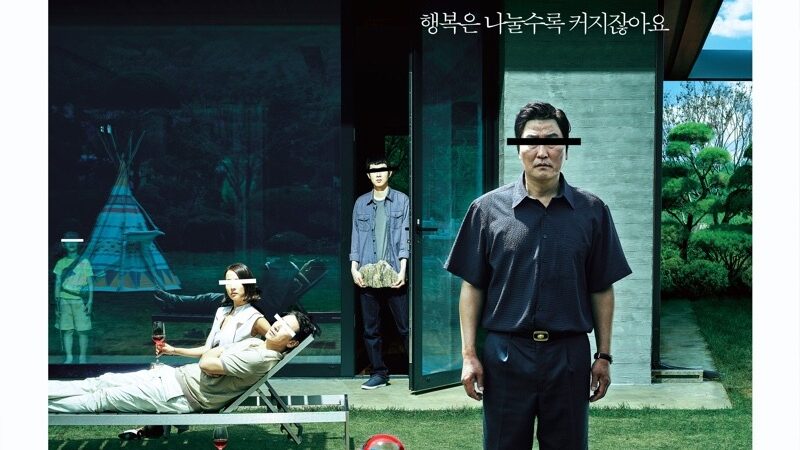
Bong Joon-ho’s Parasite is not just a film, it is an experience that lingers long after the credits roll. Released in 2019 and premiering at the Cannes Film Festival, where it won the Palme d’Or, this South Korean masterpiece stunned global audiences with its sharp storytelling and layered social commentary. Blending dark comedy, thriller, and drama, Parasite explores class division in a way that feels both intimate and disturbingly universal.
Starring Song Kang-ho, Lee Sun-kyun, Cho Yeo-jeong, Choi Woo-shik, and Park So-dam, the film presents two families living under the same sky yet worlds apart.
A Story That Slowly Tightens Its Grip
The Kim family lives in a cramped semi-basement apartment in Seoul. Ki-taek, the father, is unemployed. His wife, Chung-sook, and their two children, Ki-woo and Ki-jung, struggle to survive on temporary jobs while enduring the indignities of poverty, drunken passersby outside their window, fumigation gas seeping into their home, and constant financial anxiety.
Everything changes when Ki-woo is offered a chance to replace his friend as an English tutor for the wealthy Park family. The Parks live in a stunning modern house designed with sleek architecture, clean lines, and open space, a striking contrast to the Kims’ suffocating basement.
What begins as a simple tutoring job quickly evolves into an elaborate scheme. One by one, the Kim family members infiltrate the Park household, each assuming a fabricated identity to secure employment. Through carefully orchestrated deception, they replace the household staff and embed themselves into the lives of the unsuspecting rich family.
At first, the film plays like a clever dark comedy. The manipulation feels almost playful. But as secrets unfold and hidden truths emerge within the luxurious home, the tone shifts dramatically. Tension builds, moral lines blur, and the story descends into chaos that is both shocking and inevitable.
Characters Shaped by Class and Circumstance
Ki-taek, portrayed masterfully by Song Kang-ho, embodies quiet frustration. He is not evil, nor heroic. He is a man worn down by a system that offers him little dignity. His famous line about having “no plan” reflects a deep resignation, life, for people like him, rarely follows careful designs.
Ki-woo represents hope mixed with ambition. He genuinely believes he can climb the social ladder, whether through education or deception. His sister, Ki-jung, is sharp and resourceful, arguably the most adaptable member of the family. Together, they demonstrate intelligence and creativity, qualities that ironically go unrewarded in their social position.
On the other side, the Park family is not portrayed as villains. Mr. Park is polite yet subtly condescending. He maintains emotional distance, particularly toward those beneath him socially. Mrs. Park is naive and easily manipulated, living in comfort without fully recognizing her privilege.
What makes Parasite powerful is that no character is purely good or evil. They are products of inequality. The poor deceive to survive. The rich exploit without noticing. Everyone is trapped within an invisible hierarchy.
The Meaning Behind the Chaos
The title itself poses a provocative question: who are the real parasites?
Is it the poor family attaching themselves to wealth? Or is it the wealthy who benefit from cheap labor while remaining detached from the struggles of those beneath them?
Bong Joon-ho fills the film with visual symbolism. The most obvious is vertical space. The Kims live below ground. The Parks live high above, surrounded by light and air. Stairs become recurring imagery, characters constantly moving up and down, physically representing social mobility and its limits.
Rain, which appears romantic and refreshing to the Parks, becomes catastrophic flooding for the Kims. The same event produces comfort for one family and disaster for another. This contrast underlines the brutal reality of inequality: experiences are shaped by status.
The ending leaves viewers unsettled. Dreams of upward mobility are presented, yet they feel distant, almost impossible. The final sequence suggests that breaking free from class constraints requires more than hard work or clever planning. It requires structural change, something far beyond individual control.
Craftsmanship That Elevates Every Scene
Technically, Parasite is flawless. The cinematography by Hong Kyung-pyo enhances the contrast between light and darkness, wealth and poverty. The production design of the Park house serves almost as a character itself, beautiful, cold, and secretive.
The film’s tonal shifts, from comedy to thriller to tragedy, are handled seamlessly. Few directors can move audiences from laughter to horror within minutes without feeling forced. Bong Joon-ho achieves this with precision and confidence.
The performances are equally compelling. Every actor brings depth to morally complex roles. Expressions, pauses, and subtle gestures communicate more than dialogue ever could.
Final Thoughts: A Modern Classic
Parasite is a rare film that is both intellectually sharp and emotionally gripping. It challenges viewers to confront uncomfortable truths about capitalism, privilege, and meritocracy. At the same time, it remains deeply entertaining, unpredictable, and suspenseful.
Rather than offering easy answers, the film invites reflection. It asks how much people are willing to sacrifice for comfort, status, and survival. And perhaps most disturbingly, it suggests that the line between victim and exploiter is thinner than we would like to admit.
Verdict: A bold, genre-defying masterpiece that blends satire and tragedy with extraordinary precision.
Rating: 9.5/10