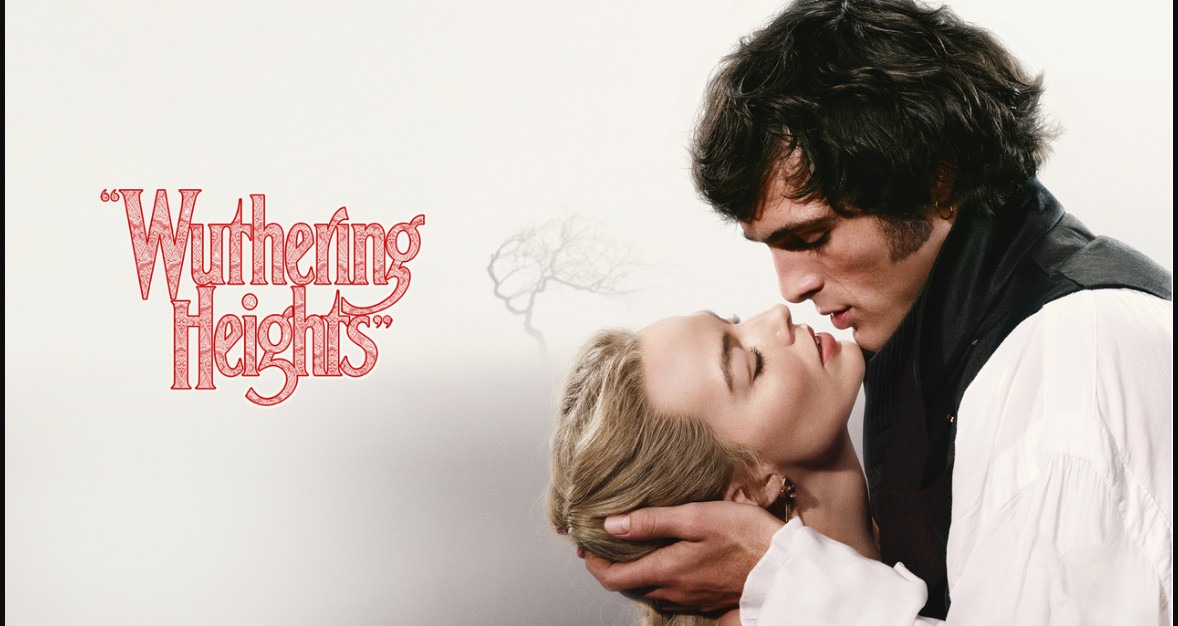
Few novels have carried the weight of reputation quite like Wuthering Heights. Marketed as “the greatest love story of all time,” the 2026 adaptation starring Margot Robbie and Jacob Elordi arrives with high expectations, bold promotional claims, and intense on-screen chemistry.
But beneath the sweeping romance and polished visuals lies a darker question: is this truly an epic love story, or simply a tale of obsession, pride, and emotional destruction?
Here’s a closer look at how the film unfolds, and what its ending really means.
A Passion Born in Isolation: The Story Unfolds
Set in 19th-century England, the story begins when Mr. Earnshaw brings home a young orphan boy and allows his daughter, Catherine Earnshaw, to raise him as her companion. She names him Heathcliff. From childhood, the two grow inseparable, forming a bond that feels deeper than friendship but is never fully defined.
As the years pass, Wuthering Heights falls into decay, mirroring Mr. Earnshaw’s descent into alcoholism and gambling. Social divisions begin to shape Catherine’s choices. Though she shares a passionate connection with Heathcliff, she becomes increasingly aware of his lower social standing.
When the wealthy Edgar Linton enters her life, Catherine sees an opportunity for status, comfort, and security. Heathcliff, wounded by her ambition and overhearing only part of her confession, where she appears to degrade him, leaves Wuthering Heights without warning.
Catherine waits, but eventually marries Edgar and moves into the luxurious Thrushcross Grange. Years later, pregnant with Edgar’s child yet emotionally restless, she is confronted by Heathcliff’s dramatic return, now wealthy, refined, and determined.
What follows is not reconciliation, but revenge.
Heathcliff purchases Wuthering Heights and manipulates his way back into Catherine’s orbit. Their unresolved feelings erupt into a secret affair, conducted behind Edgar’s back. Jealousy, pride, and cruelty dominate their interactions. In retaliation for Catherine’s rejection, Heathcliff marries Edgar’s sister Isabella, not for love but as a weapon.
The affair is exposed. Catherine, emotionally unstable and feeling trapped, isolates herself. She refuses food and shuts herself away. Her pregnancy ends in tragedy, and her physical condition deteriorates rapidly.
By the time Heathcliff learns she is dying, it is too late.
He arrives only to find Catherine lifeless, having bled to death. In a moment of raw devastation, he clings to her body and begs her spirit to haunt him for the rest of his life.
Love, in this version, does not redeem. It destroys.
Catherine and Heathcliff: Romance or Ruin?
At the center of the film lies a relationship that is often mistaken for romance but functions more like mutual self-destruction.
Catherine is driven by desire, for passion, yes, but also for status and comfort. She cannot reconcile her emotional bond with Heathcliff and her ambition to rise socially. Her tragedy stems from this internal division.
Heathcliff, meanwhile, embodies wounded pride. His love curdles into obsession. Rather than seeking understanding, he chooses retaliation. His marriage to Isabella and emotional manipulation of Catherine reveal a man more interested in possession than partnership.
The chemistry between Robbie and Elordi is undeniable. Their physical scenes are intense and visually striking. Yet emotional depth often takes a back seat to sensual tension. The novel’s social commentary, class struggle, generational trauma, and moral decay, feels softened, almost secondary.
Instead of two tormented souls shaped by a harsh world, the film presents two lovers trapped by miscommunication and ego.
Misunderstanding, Pride, and the Meaning of the Ending
The final act hinges on one painful truth: Catherine and Heathcliff are separated not by fate, but by pride and silence.
Heathcliff leaves after hearing only part of Catherine’s confession. Catherine never fully explains herself. Years later, neither chooses vulnerability over vengeance. Their affair becomes less about love and more about reclaiming wounded identity.
When Catherine dies believing Heathcliff no longer truly loves her, and Heathcliff arrives too late to save her, the tragedy feels preventable. One honest conversation might have changed everything.
His plea for her ghost to haunt him reinforces the film’s central theme: he would rather suffer eternally with her memory than live peacefully without her.
This is not a love that heals. It is a love that consumes.
A Visually Polished but Emotionally Diluted Adaptation
Despite strong performances and undeniable chemistry, this adaptation struggles to capture the gothic intensity of Emily Brontë’s original novel.
Having studied the text in university, I couldn’t help but feel that the film smooths out the novel’s raw brutality. The source material is unsettling, layered with psychological complexity and social critique. The film, however, leans heavily into erotic tension and romantic marketing.
Viewed independently from the novel, Wuthering Heights (2026) works as a tragic romance. The pacing is steady, the cinematography atmospheric, and the performances committed.
But as an adaptation, it feels simplified.
The marketing calls it the greatest love story of all time. What it truly presents is a cautionary tale about pride, class ambition, and emotional immaturity.
Final Thoughts: Should Hollywood Leave the Classics Alone?
There is no denying that Margot Robbie and Jacob Elordi share powerful on-screen chemistry. Some scenes are bold and emotionally charged. Yet chemistry alone cannot replace thematic depth.
This version of Wuthering Heights feels more inspired by the idea of the novel than faithful to its soul. It romanticizes what was originally harsh and morally ambiguous.
As a standalone film, it is a watchable tragedy.
As an adaptation of a gothic masterpiece, it falls short.
Rating: 8 out of 10 stars
It is passionate. It is dramatic.
But it is not the definitive love story it claims to be.