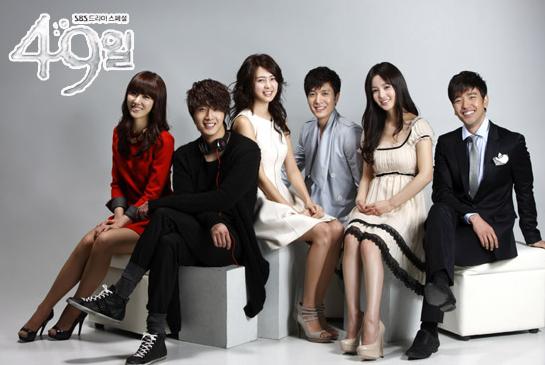
In the pantheon of Korean television, certain dramas act as mere entertainment, while others serve as emotional landmarks. 49 Days, aired in 2011 by SBS, belongs firmly to the latter category. For many international fans, it was the “gateway drug” into the world of high-concept K-melodramas. But even 15 years later, as we look back from 2026, the series remains an unparalleled exploration of the human condition, grief, and the terrifying fragility of social bonds.
If you are a regular reader of masasha.net, you know we value stories that resonate beneath the surface. 49 Days doesn’t just ask “What happens after we die?” It asks the much more uncomfortable question: “How did we actually live?”
1. The Anatomy of the 49-Day Journey
At its core, the drama utilizes the Buddhist belief in the “Bardo” or intermediate state—the 49 days a soul spends wandering before transitioning to the afterlife.
Shin Ji-hyun (played with infectious optimism by Nam Gyu-ri) is the catalyst. She is the “Princess Optimist,” a woman whose life is a vibrant tapestry of wealth, upcoming marriage, and friendship. When a freak accident puts her in a coma, the universe offers her a cosmic loophole: find three people outside her immediate family who will shed three “pure” tears of genuine love for her.
The catch? She must do this while inhabiting the body of Song Yi-kyung (Lee Yo-won), a woman who has lost all will to live. This body-swap isn’t played for laughs; it is a visceral juxtaposition of a soul desperate to return to life and a body desperate to leave it.
2. Lee Yo-won: The Duality of Despair and Hope
The heavy lifting of 49 Days (2011) rests on the shoulders of Lee Yo-won. In 2011, this performance set a gold standard for dual roles in Hallyu.
- As Song Yi-kyung: She is a phantom. Her movements are sluggish, her eyes are vacant, and her environment—a cramped, dark apartment—reflects her internal decay. She works the night shift at a convenience store, a symbolic choice for someone hiding from the light of the world.
- As Ji-hyun in Yi-kyung’s body: The transformation is remarkable. Lee Yo-won manages to adopt Nam Gyu-ri’s mannerisms—the frantic energy, the wide-eyed naivety, and the subtle “rich girl” clumsiness—without it feeling like a caricature.
This duality serves a deeper narrative purpose. It forces the audience to see how the same physical vessel can be perceived differently based on the “light” of the soul within. It is a masterful performance that remains one of the highlights of Lee Yo-won’s storied career.
3. The Deconstruction of the “Perfect” Circle
The middle act of 49 Days (2011) is where the drama earns its “insightful” reputation. As Ji-hyun (as Yi-kyung) spies on her former life, the “Perfect Book” of her existence begins to burn.
The Treachery of Min-ho and In-jung
The betrayal by her fiancé Kang Min-ho (Bae Soo-bin) and best friend Shin In-jung (Seo Ji-hye) is one of the most agonizing arcs in K-drama history. Unlike modern “makjang” dramas where villains are cartoonishly evil, 49 Days (2011) paints them with shades of resentment.
In-jung’s betrayal isn’t born from a vacuum; it’s born from years of feeling like the “poor friend” to the “perfect princess.” The drama explores the toxicity of “inferiority complexes” within female friendships, a theme that feels incredibly relevant in our modern, social-media-driven world where “perceived perfection” often fuels silent envy.
Han Kang: The Recognition of the Soul
On the opposite end of the spectrum is Han Kang (Jo Hyun-jae). His role is the emotional anchor. In a world where Ji-hyun’s “loved ones” fail her, Han Kang—the man she thought hated her—is the only one who recognizes her soul through a different face. This subverts the “romance” genre; it suggests that true love isn’t about physical attraction or shared history, but a spiritual recognition.
4. The Scheduler: A Modern Reaper
Long before Goblin gave us the fashionable Grim Reaper, Jung Il-woo gave us The Scheduler.
The Scheduler is a breath of fresh air in an otherwise heavy melodrama. He is cynical, tech-savvy (using a smartphone to manage souls in 2011!), and strictly adheres to “Heaven’s Protocol.” However, his evolution from a detached observer to someone who breaks rules for Ji-hyun is beautiful.
His backstory with Yi-kyung provides the final emotional hammer of the series. It ties the supernatural elements back to a very human story of misunderstood love and tragic timing.
5. Philosophical Insight: The Rarity of a “Pure Tear”
The most profound concept in 49 Days is the Tear Bottle. The Scheduler explains that most tears are shed for oneself—out of guilt, out of the pain of losing someone who served you, or simply out of pity. A “pure tear” of selfless love is a rare commodity.
This is a stark commentary on human ego. When Ji-hyun realizes how difficult it is to collect even three drops, the drama shifts from a quest for life into a meditation on the quality of the life she led. It forces us, the viewers, to audit our own relationships. If we were to fall into a coma today, how many of those crying at our bedside would be crying for us, and how many for themselves?
6. Technical Brilliance: Why it Still Holds Up
From a production standpoint, the drama utilized a color palette that reflected the emotional state of the characters. The cold, blue-ish hues of Yi-kyung’s life contrast sharply with the warm, sun-drenched memories of Ji-hyun’s past.
The OST, featuring tracks like “The Scarecrow” and “Even if I Live Just One Day,” remains iconic. In the 2026 streaming era, where music is often generic, these songs are intrinsically tied to the plot, acting as the internal monologue for characters who are often forbidden from speaking their truth.
7. The Ending: A Brave Narrative Choice (Spoilers Ahead)
Most dramas of the era would have opted for a “happily ever after.” 49 Days chose the path of “meaningful ending.”
The final twist—that Ji-hyun’s fate was already sealed and the 49 days were merely a grace period—is a bold narrative move. It elevates the story from a simple “survival” tale to a lesson in acceptance. It teaches that the value of life isn’t measured by its length, but by the clarity we gain before we go.
The revelation that Yi-kyung and Ji-hyun were long-lost sisters adds a layer of “destiny” that ties the entire universe of the show together, suggesting that no encounter in life is accidental.
8. Heartbreak Revisited: Top 5 Emotional Moments in ’49 Days (2011)’
To truly understand why this drama is a “tear-jerker” hall-of-famer, we have to revisit the scenes that shattered our hearts. If you’re rewatching, keep a box of tissues nearby for these specific milestones:
- The First Pure Tear: After episodes of betrayal and despair, the moment Ji-hyun finally receives her first “pure tear” is a cinematic sigh of relief. The mystery of whose tear it was (and the realization of who didn’t cry) remains one of the best cliffhangers in Hallyu history.
- The Scheduler’s Goodbye: The reveal that the Scheduler is actually Song Yi-soo, Yi-kyung’s late boyfriend, is a masterstroke. Their final meeting—where they get to say the goodbyes they were robbed of—is perhaps more heartbreaking than Ji-hyun’s own journey.
- Han Kang’s Silent Recognition: There is a scene where Han Kang looks at Yi-kyung (possessed by Ji-hyun) and simply knows. He doesn’t need a magic necklace; he recognizes her through her habits and her spirit. It’s a quiet, powerful moment of validation for Ji-hyun’s existence.
- Ji-hyun Watching Her Own “Death”: Watching your loved ones mourn (or plot against) you while you stand right next to them in a borrowed body is a unique kind of torture. The scene where she witnesses Min-ho and In-jung’s secret affair is the moment the “Princess” truly grows up.
- The Final Elevator Scene: The series finale subverts every expectation. Ji-hyun entering the elevator after realizing her 49 days were just a “bonus” time to settle her affairs is a profound lesson in the inevitability of death. It wasn’t about the destination; it was about the closure.
9. Where are they now? The Cast in 2026
It has been 15 years since 49 Days first graced our screens. The cast has since become royalty in the Korean entertainment industry. Here is a quick update on where the stars are as of early 2026:
Lee Yo-won (Song Yi-kyung / Shin Ji-hyun)

2026 Status: Still the “Queen of Melodrama.” She remains highly selective with her scripts. Following her success in the 2024 noir hit Green Mothers’ Club, she recently starred in a high-stakes legal thriller that dominated global streaming charts in late 2025.
Nam Gyu-ri (Shin Ji-hyun)

2026 Status: Successfully balancing her career as a singer and actress. She recently made a major comeback with a soulful ballad for a Triple-A game soundtrack and a lead role in a 2025 romantic comedy that trended on social media for weeks.
Jung Il-woo (The Scheduler)

2026 Status: A Hallyu icon who seemingly hasn’t aged a day since 2011. In 2026, he is heavily active in the global variety circuit and high-budget historical dramas (Sageuk), where he is praised for his mature, nuanced acting.
Seo Ji-hye (Shin In-jung)
2026 Status: Transformed her image from the “hated villain” of 2011 to a top-tier leading lady. Following her global breakthrough in Crash Landing on You, she spent 2025 headlining multiple “Big Three” network dramas.
Jo Hyun-jae (Han Kang)

2026 Status: After a brief hiatus to focus on his family life, he returned to the screen in 2025 with supporting roles that highlight the “gentle charisma” that first won over international fans during the 49 Days era.
Conclusion: Why Masasha Readers Should Watch (or Rewatch) This
49 Days (2011) is a rare gem that survives the “nostalgia trap.” It is as gut-wrenching today as it was in 2011. For a pop-culture niche blog with a global audience, this drama represents the peak of Korean storytelling—where the supernatural is merely a lens to view the profoundly natural.
It is a story about the strength found in the midst of depression, the ugly truth behind “perfect” friendships, and the hope that comes from knowing that even one sincere connection can justify an entire existence.